
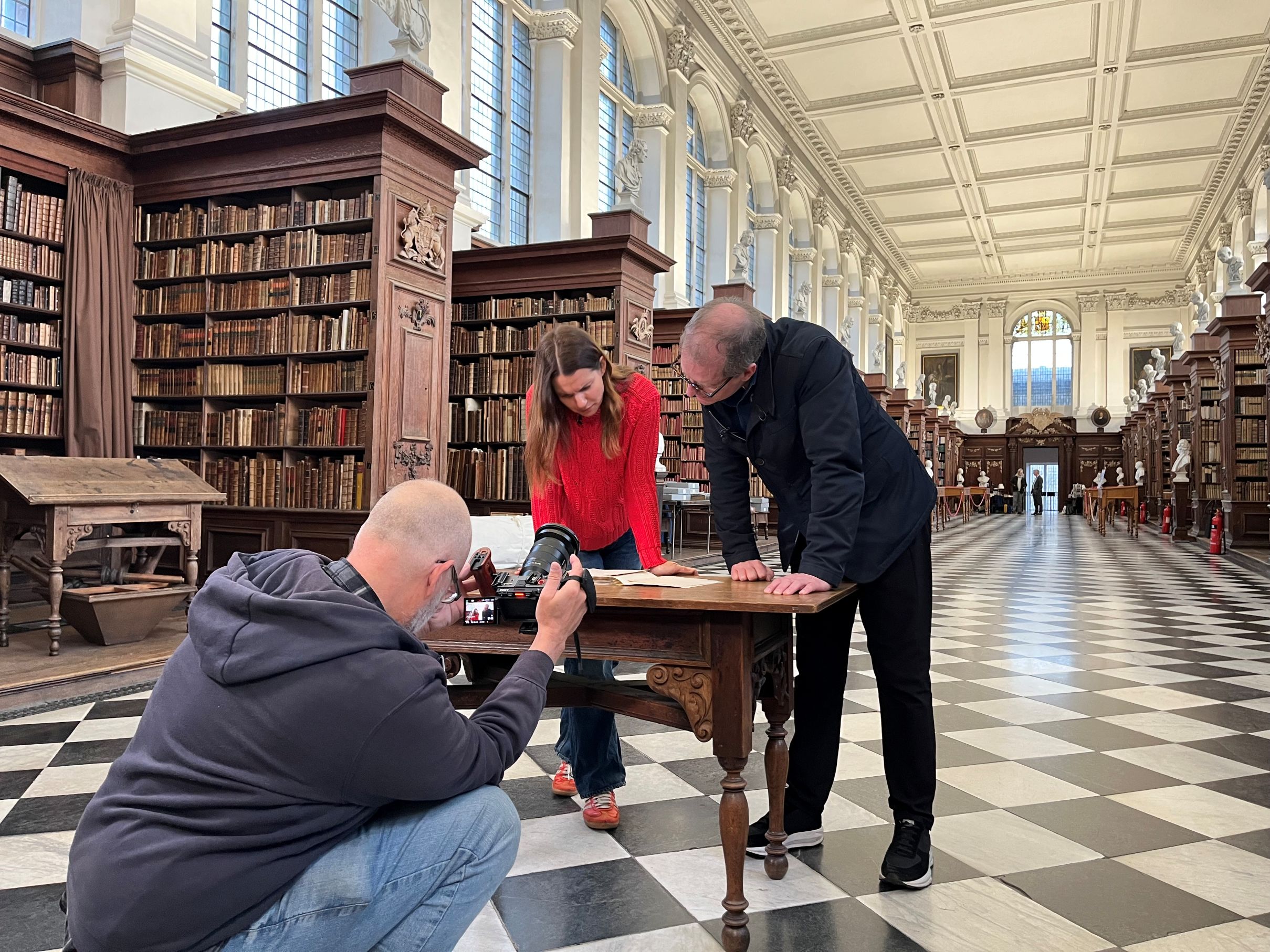
He came to Trinity to study mathematics at the start of the twentieth century and left the world an unlikely but enduring legacy: Winnie-the-Pooh and his charming friends.
Alan Alexander Milne’s ‘Bear of Very Little Brains’ first appeared in print 100 years ago, in the Christmas Eve edition of The Evening News, a popular London paper.
Such had been the success of When We Were Very Young, Milne’s first collection of verse for children, published in 1924, that The Evening News gave him top-billing.
The front page announced:
A CHILDREN’S STORY BY A A MILNE
‘A new story for children ‘Winnie-the-Pooh’ about Christopher Robin and his Teddy Bear, written by Mr A A Milne, specially for the Evening News’ …
‘Winnie-the-Pooh’, a half-page story about ‘the wrong kind of bees’, was first time the bear owned by Milne’s son bore that name. Previously, he had been ‘Mr Edward Bear’ or ‘Teddy Bear.’
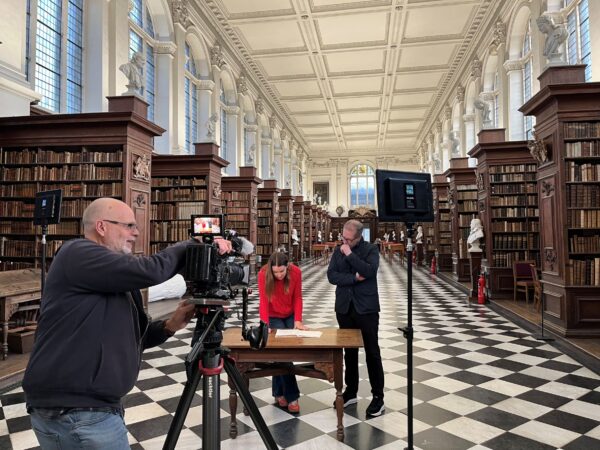
AA Milne (1882-1956) was a man of contradictions. He came to Trinity on a scholarship to study maths but loved writing – he edited the student magazine Granta – and playing football and cricket.
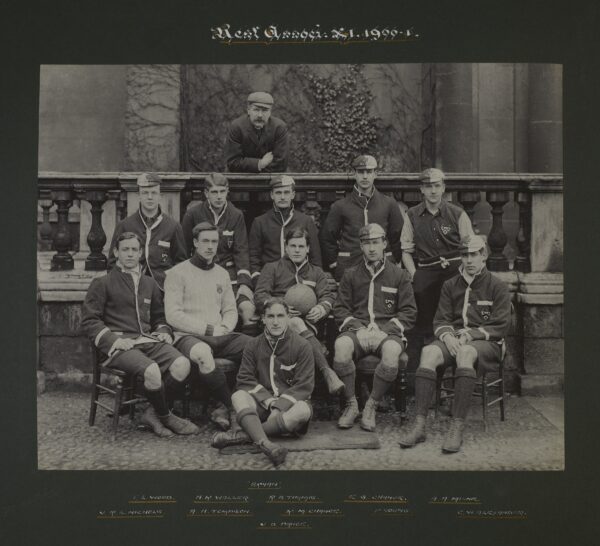
After graduating in 1903, he wrote for Punch, becoming assistant editor. There he met, but was initially unimpressed, by EH Shepard’s work.
In his print debut in The Evening News, Winnie-the-Pooh was drawn by JH Dowd. Pooh was not ‘quite looking himself’, as Ann Thwaite, Milne’s biographer, points out. But he had started his public life.
The success of When We Were Very Young, ‘with decorations by EH Shepard,’ led to their partnership on three more books: Winnie-the-Pooh (1926), Now We Are Six (1927) and The House at Pooh Corner (1928).
Shepard visited the Milne family at their Cotchford Farm home, close to Ashdown Forest, which inspired the Hundred-Acre Wood, to get a sense of the place where Christopher Robin, Pooh, Eeyore, Piglet, Tigger, Kanga and Roo adventured.
Before the Pooh books, Milne was a well-known playwright, with 18 plays and three novels published. That he became famous around the world as a writer of children’s verse was to frustrate him in later life.
Writing a short autobiographic article for the New York Herald Tribune in 1952, Milne, then aged 70, said of his children’s books:
‘When I wrote them, little thinking
All my years of pen-and-inking
Would be almost lost among
Those four trifles for the young.’
Fame also proved problematic for Christopher Robin Milne. At boarding school he was teased mercilessly and later in life came to resent the eponymous stories.
In By Way of Introduction (1929) Milne acknowledged that the dividing line between what he saw as the imaginary and the legal Christopher Robin had become fainter with each book.
I feel that the legal Christopher Robin has already had more publicity than I want for him. Moreover, since he is growing up, he will soon feel that he has had more publicity than he wants for himself.
CR Milne also studied at Trinity. He went on to run a bookshop in Dartmouth.
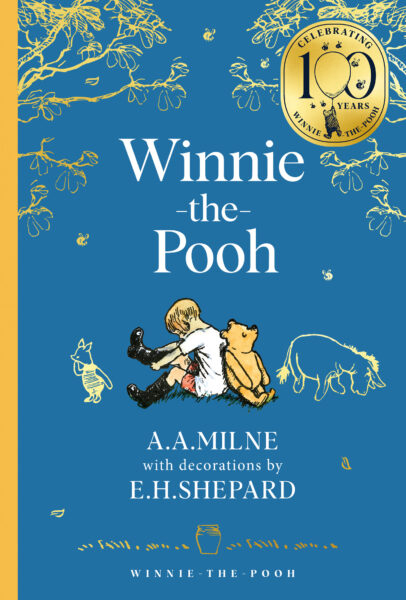
The publisher Farshore is celebrating the centenary with facsimile editions and a new sequel, A Little Boy and His Bear, written by Jane Riordan and illustrated by Andrew Grey, which will be released next October, 100 years since Winnie-the-Pooh was published.