
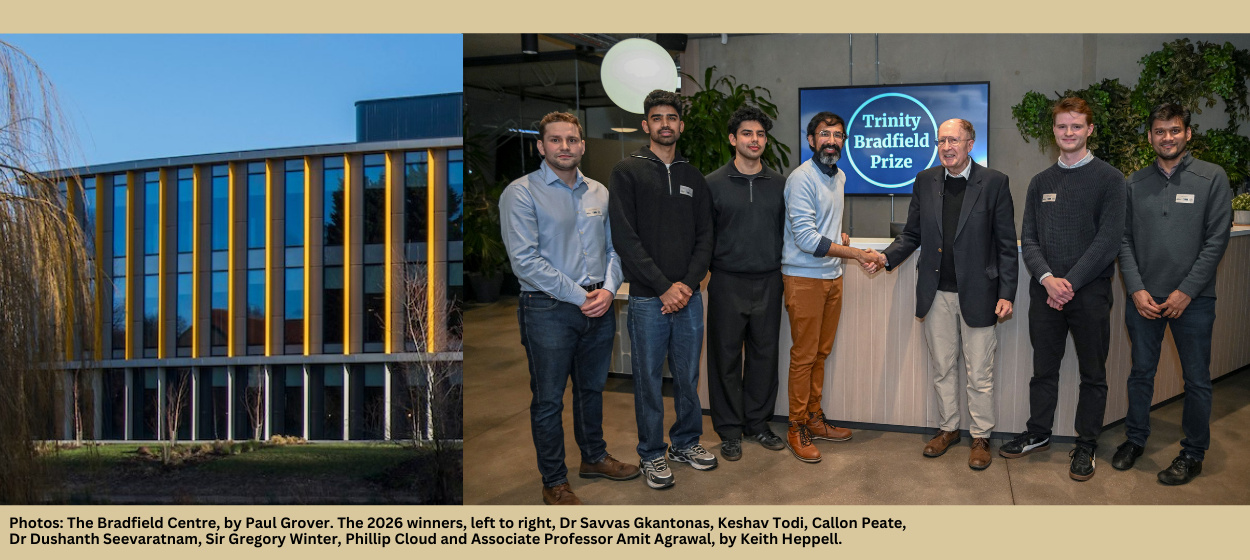
Seaweed-based biofuel, carbon-eating concrete and a super-thin material heralding advances in quantum technologies have won this year’s Trinity Bradfield Prizes.
Callon Peate and Dr Dushanth Seevaratnam’s GreenMixes won the £10,000 first prize for a modified biochar – a form of charcoal compatible with cement – which when added to concrete sequesters carbon in a building material notorious for its contribution to climate change.
Keshav Todi and Dr Farhan Aslam’s Maricene secured the £5,000 second prize for their bioengineered marine yeast, derived from seaweed, which creates a biofuel without relying on arable land or fresh water. Biofuels are sustainable alternatives to fossil fuels.
Phillip Cloud and Dr Amit Agarwal’s Phaseshift won the £5,000 Hellings Prize, with a new photonics platform that could replace the big, bulky systems that control quantum functions with miniaturised components of greater accuracy for use in computing, sensing, biomedical imaging and display technology.
Dr Savvas Gkantonas’ Pinepeak won the £10,000 Angel Prize – which is awarded to a previous winner demonstrating the most progress – for their physics and AI-informed prediction of wildfires worldwide and ability to support decision-making about how fires are managed on the ground.

This seventh edition of the Trinity Bradfield Prize attracted teams with representatives from 18 departments and 19 colleges at Cambridge.
Each finalists pitched their innovation to a packed audience at the Bradfield Centre after which the judging panel, led by former Master of Trinity Sir Gregory Winter, selected the winners.
James Parton, Managing Director of the Bradfield Centre at Cambridge Science Park, said it was the best competition yet.
The Trinity Bradfield Prize has become a leading showcase of the world-leading science and technology emerging from the University of Cambridge. More than 500 teams have applied to the competition since its inception, and an impressive number of previous finalists have gone on to create exciting new companies, raising more than £15m in venture backing.
‘In addition to the cash prizes and exposure they gain from participating in the competition, all of our finalists benefit from subject matter expert mentoring, introductions to investors, and complementary membership of The Bradfield Centre to help grow their ventures,’ said Mr Parton.
Find out more about the 2026 Trinity Bradfield Prize winners.
GreenMixes
Unlike ordinary biochar – which is created by heating or carbonizing organic material at high temperatures – GreenMixes’ modified version does not reduce the strength of concrete. It will be used as another ingredient in concrete alongside cement, sand, aggregates and water.
Callon and Dushanth developed the idea at the Institute for Manufacturing when discussing the scale of construction waste and emissions in rapidly developing countries such as India.
Concrete contributes a significant percentage of worldwide CO2 emissions.
Callon said: ‘I had been following the use of biochar in agriculture and its carbon-sequestration potential. With our backgrounds in chemistry, nanoscience, and manufacturing, we believed we could engineer biochar specifically for cementitious systems rather than treating it as a generic filler – and that insight led directly to GreenMixes.’
Within six months, initially using a home lab, they had developed their proprietary biochar. The Trinity Bradfield Prize will enable GreenMixes to increase production, conduct more pilot studies and increase validation studies.
Callon said: ‘The aim is for GreenMixes concrete to be used in the same way as conventional concrete, with equivalent strength and durability for the targeted application. Our initial focus is non-structural and precast applications, where certification pathways are faster, before expanding into increasingly structural uses as the data package and approvals mature.’
Maricene
Maricene marries biotechnology with resource efficiency.
Biofuels are typically created from organic matter grown on arable land, thereby creating competition with food production. Maricene has removed this conflict, says Dr Farhan Aslam. ‘By valorising seaweed residue that was previously considered waste, we have unlocked a path to advanced biofuels that require zero arable land or fresh water,’ he said.
Seaweed is already harvested and processed to extract gel-forming substances used in a wide range of foods and in medicines. Keshav Todi said: ‘The “lightbulb moment” was when we realized we could also use our strain with this residue instead of fresh seaweed; this saves on feedstock costs while simultaneously utilizing an unwanted waste product.’
Winning the Trinity Bradfield Prize was a pivotal moment for Maricene, said Keshav. ‘It provides not only capital but also the institutional validation required to move our technology from the laboratory into the industrial market.’
The new bioethanol will be created in large, aerated tanks containing seaweed remnants and Maricene’s proprietary yeast strain.
Phaseshift
Photonics – the science and technology of light – enables much of what we rely on daily today: screens and cameras in smart phones, lighting in our homes and cars, and computer and television screens.
This key enabling technology has many applications – if the systems that control quantum technologies become more accurate, less cumbersome and cheaper than the current large and expensive mechanisms.
Phaseshift’s Dr Amit Agrawal has developed an alternative breakthrough technology, which has a wide range of uses in industries such as quantum sensing, display technology and biomedical imaging.
Phillip Cloud said: ‘Our technology is to take traditional optical components which are big, bulky and require constant realignment and shrink them to a chip, offering 10-100x miniaturisation. We replace them with components – photonic integrated circuits (PICs) and metasurfaces.
Our specific expertise is in how to build these systems for quantum where we can help to scale them to larger sizes while improving performance and robustness.’
Dr Agrawal, who is a Trinity Fellow, said the Trinity Bradfield Prize would help the company expand its customer base, protect its intellectual property, and generate funding for research and development.
‘The Cambridge ecosystem is particularly rich in quantum, photonics and semiconductors and we are excited to make use of that,’ said Phillip.
Pinepeak
Born out of jet engine research at Cambridge’s Engineering Department, Pinepeak’s FLAMESIGHT technology is a bit like weather forecasting, but for wildfires.
‘By providing precise forecasts and analytics, down to the individual building, Pinepeak aims to improve re/insurance coverage, strengthen community climate resilience, and empower emergency responders in the fight against wildfires as risks evolve across the global built environment,’ said Dr Gkantonas.
Winning the Angel Prize was a great validation for the team, he said. ‘It recognises the progress we’ve made in turning a big, ambitious idea out of the lab into something that can solve real-world problems across multiple sectors.’
The team is focused on further deploying and testing the platform with partners in insurance and risk management, and getting this technology into the hands of the people who need it on the ground.