
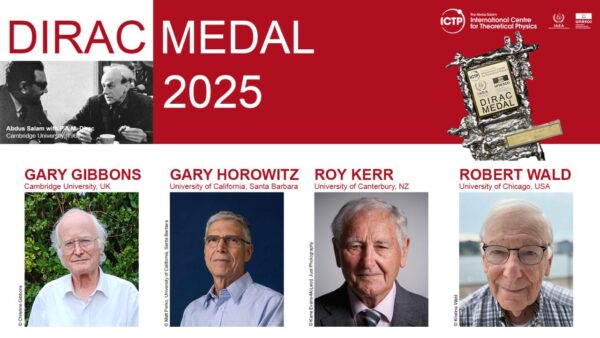
Trinity Fellow Professor of Theoretical Physics Gary Gibbons has received the 2025 Dirac Medal for redefining our understandings of gravity through his research into black holes.
Professor Gibbons is one of four theoretical physicists recognised by the Abdus Salam International Centre for Theoretical Physics (ICTP) this year. The others are Gary Horowitz, University of California Santa Barbara, Roy Kerr, University of Canterbury in New Zealand, and Robert Wald, University of Chicago.
The award recognizes ‘their landmark contributions which have significantly shaped the study of general relativity across many generations. Their work collectively has laid the conceptual and technical foundations of our understanding of gravity, at both the classical and quantum levels.”
The ICTP said: ‘The work of the 2025 Dirac Medallists gives a wide perspective on gravity and has impacted physicists’ efforts to understand the weakest of all fundamental forces and formulate its quantum description.’
The winners’ research shows how theoretical exploration can lead to remarkable insights about the physical world, even in the absence of guidance from direct observation.
Trinity Fellow Professor of Theoretical Physics David Tong said this year’s winners stood out as the great pioneers of General Relativity over the past 50 years.
Trinity Fellow Professor of Theoretical Physics Malcolm Perry said: ‘Gary Gibbons’ contributions to the study of gravitation have probed the very fundamental nature of the Universe in which we live.’
Among his most significant work is greater understanding of the physics of black holes. Professor Perry explains:
Black holes often form when a star dies. Once it runs out of its nuclear fuel, if the star is big enough there is nothing to stop it collapsing under its own weight until a black hole forms.
A black hole is a region of space where gravitation is so strong that light cannot escape. Inside every black hole, there is a spacetime singularity, where space and time as we know it come to an end.
During his graduate studies many scientists did not believe black holes could exist but, said Professor Perry:
Gary did not follow the conservative track and this has led to a deep exploration of the properties of black holes.
His most notable paper in this regard is the application of quantum mechanical ideas to the physics of black holes. He used the methods of quantum field theory to derive the entropy of black holes.

Black hole entropy is a complete mystery, says Professor Perry. ‘It is completely unlike the thermodynamic entropy of everyday systems where entropy represents the amount of disorder in a system and continuously increases. A different way of explaining entropy is that it is a measure of the microscopic complexity of a system.’
Neither description fits with our picture of black holes described by general relativity,’ said Professor Perry. ‘So Gary’s contribution here leaves us with a puzzle that has withstood around 50 years of exciting but unresolved exploration.’
That’s perhaps fitting as Professor Gibbons says he was originally drawn to theoretical physics ‘because it is the foundation underlying all of the sciences and yet is incomplete.’
He has published 394 academic papers and made huge contributions beyond black holes to areas of gravitational research, both in its classical description using general relativity and the beginnings of a quantum theory of gravity that it essential for gravity to be unified with the rest of physics.
‘The Dirac medal is a celebration of these achievements,’ said Professor Perry.
The award came as a surprise to Professor Gibbons, who completed his undergraduate studies and PhD research at Cambridge, collaborated with Professor Stephen Hawking and was elected a Fellow of Trinity in 2002.
The Dirac Medal is named after the theoretical physicist and mathematician Paul Dirac, one of the founders of quantum mechanics, who was Lucasian Professor of Mathematics at Cambridge and shared the 1933 Nobel Prize in Physics.