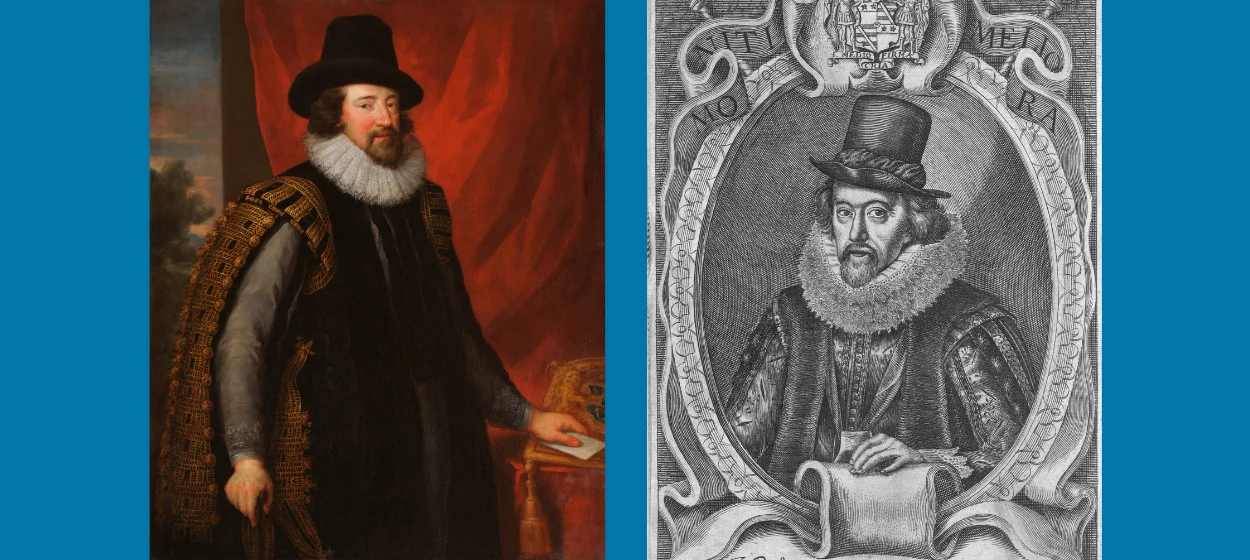
A new exhibition about Francis Bacon, who laid the foundations for modern science, has opened in Trinity College’s Wren Library, marking 400 years since his death.
Francis Bacon (1561-1626) studied at Trinity, became a government lawyer and was appointed Lord Chancellor, the highest legal office in seventeenth-century England, before he was impeached for accepting bribes.
But his fall from grace was the making of him, according to Trinity Fellow Professor Richard Serjeantson, who curated the exhibition.
It allowed him the time to write all the books he had never had time to write before. Those turned out to be greatest philosophical works of the English Renaissance.
Rare editions of some of these works – including the Advancement of Learning, Essays and New Organon – feature in the Wren Library exhibition, which charts the development of Bacon’s thinking and his lifelong connection to Cambridge. Professor Serjeantson said:
Bacon was a polymath who claimed “all knowledge to be my province.”
He wasn’t just an expert in science and in his professional sphere of law, he also wrote on history, rhetoric, architecture, gardens, on religion. He also wrote plays and poetry.
This was a man who could do anything and was acknowledged by his contemporaries as a master of all these arts.
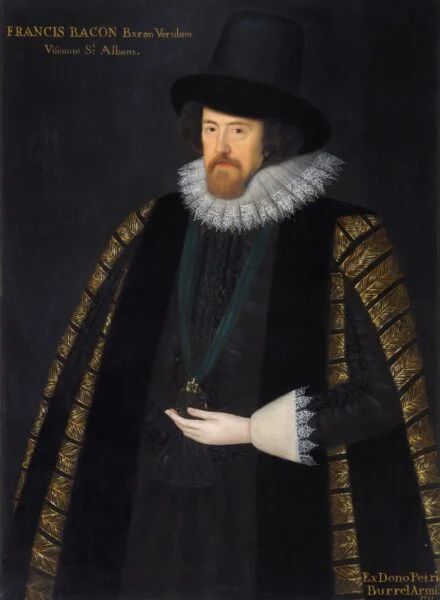
His most important contribution was the invention of the idea that the world around us could and should be investigated by active experiment – this shaped the development of the natural sciences in the seventeenth century and beyond.
‘He had a vision for how the world might be transformed for the better by a greater understanding of nature – a vision which many later generations sought to realise,’ said Professor Serjeantson.
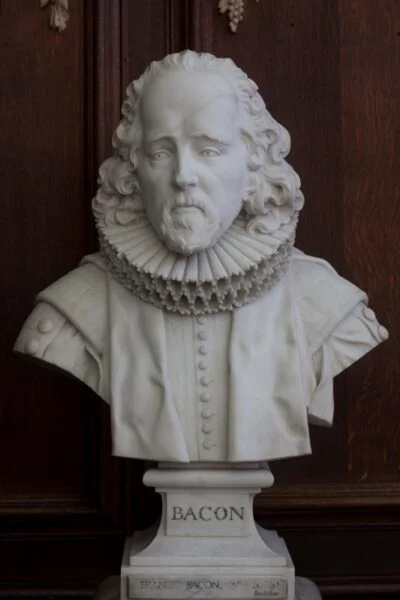
Francis Bacon was born shortly after the accession of Queen Elizabeth I to a leading family of the time – his father Sir Nicholas Bacon became Lord Keeper of the Great Seal.
Arriving at Trinity in 1573, aged 12, Francis, and his brother Anthony, were taught by the Master of the College, John Whitgift.
They studied natural philosophy, a tradition inherited from ancient Greece, which became important in the European Renaissance. This perspective emphasized the importance of understanding nature in a contemplative and speculative way.
By contrast, Bacon thought that nature should be ‘vexed,’ said Professor Serjeantson.
He emphasized the necessity of an active understanding of nature, and interventions in nature, which would change how it operated and therefore deepen our understanding of it, and ultimately give us power over it.
For Bacon, the printing press, the compass and gunpowder were the great discoveries of his age. He was very conscious that he didn’t have any major discoveries of his own to offer the world, said Professor Serjeantson.
But what he did have was a powerful conviction of himself as a trumpeter of a new scientific age, someone whose ideas would inspire people to go away and do the kind of experiments that would change our understanding of nature.
He outlined his overarching philosophical framework in New Organum (1620), which also included his proposals for conducting experiments, often using instruments, to deduce how natural phenomena worked. Bacon himself used musical instruments to investigate the nature of sound.
Such was his belief in the need to investigate the world that his most ambitious book, The Advancement of Learning (1605) is an encyclopedia of what was not known about the world at the time.
It was a landmark in the development of the idea that knowledge should be progressive and cumulative, says Professor Serjeantson.
The exhibition in the Wren Library also includes Bacon’s Essays (1580) – the first work to be given this title in English and his most popular book at the time. These pithy writings – on architecture, gardening, politics and love, to name but a few of their subjects – continue to offer practical wisdom to today’s readers.
Also relevant today is Bacon’s utopian The New Atlantis (1626), a fictional story about a South Pacific island populated by scientists pursuing the kind of discoveries he thought would be most important for human life.
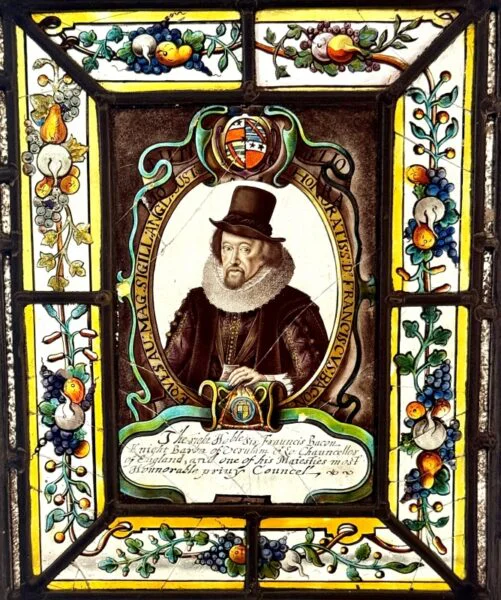
After his short-lived appointment to the role of Lord Chancellor, Bacon was created Baron Verulam in 1618 and Viscount St Albans in 1621.
Notwithstanding his downfall after being convicted of accepting bribes from those whose cases he heard in court, Bacon was astute and some might say cunning.
A notebook survives of his jottings of who he should curry favour with, how he should present himself and other ideas intended to further his status in life.
Indeed, Bacon was inspired by Niccolò Machiavelli, whose writings he greatly admired and whose lessons he absorbed, says Professor Serjeantson.
Although Bacon’s eloquence and learning commanded respect in his own lifetime, one contemporary – his physician – recognised his Machiavellian abilities with the observation that he had “a viper’s eye”.
Bacon remained committed to his cause, even to his death.
During a journey in wintry conditions, he stopped his carriage to buy a chicken. He wanted to find out how long a dead bird might last if stuffed with snow. Unfortunately, he caught a cold and became ill from this endeavour, and days later died.
‘Lord of Induction and of Veralum: Francis Bacon after 400 years’ is open to visitors to the Wren Library weekdays 12-2pm and Saturday mornings during term-time, 10.30am-12.30pm. The exhibition runs from 9 April until 15 June 2026. https://www.trin.cam.ac.uk/library/visitors/
Cover images, courtesy of Trinity College Cambridge.