
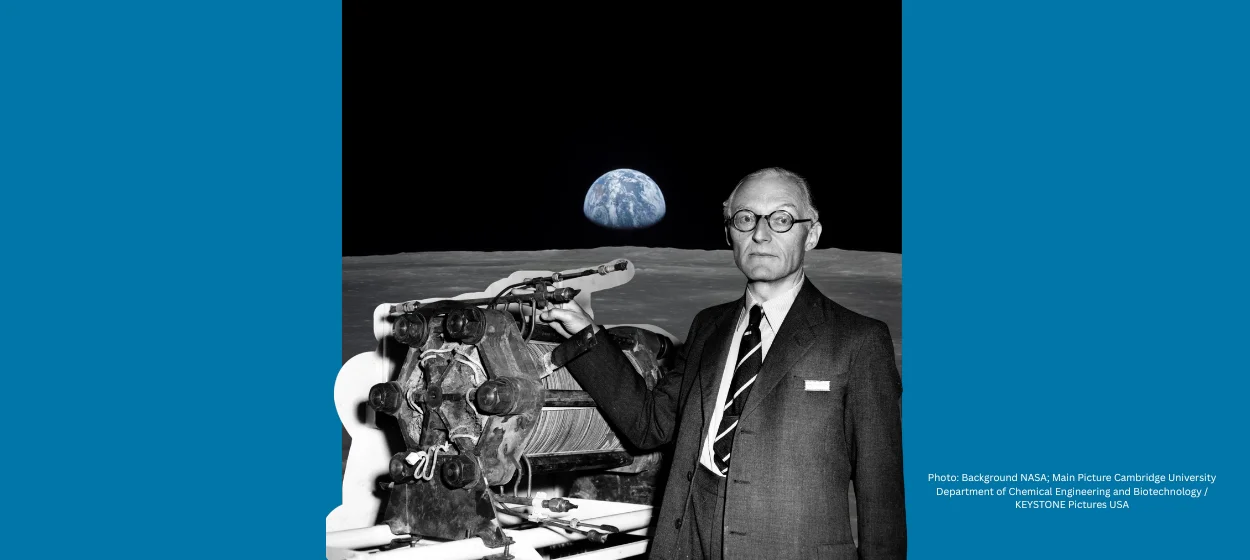
American President Richard Nixon was speaking to Trinity alumnus and chemical engineer Tom Bacon in the wake of Apollo 11 landing the first man on the Moon in 1969.
Francis Thomas Bacon (1904–1992) studied Mechanical Sciences at Cambridge 1922-1925 and went on to develop the first practical hydrogen-oxygen fuel cell.
He was a descendant of Sir Francis Bacon (1561–1626), the natural philosopher and statesman, who also studied at Trinity, nearly 350 years earlier.
Tom Bacon’s invention helped power NASA’s Apollo missions of the 1960s. Technology has naturally advanced – solar has replaced fuel cells and Artemis II’s trajectory takes human beings the furthest they have ever travelled in space.
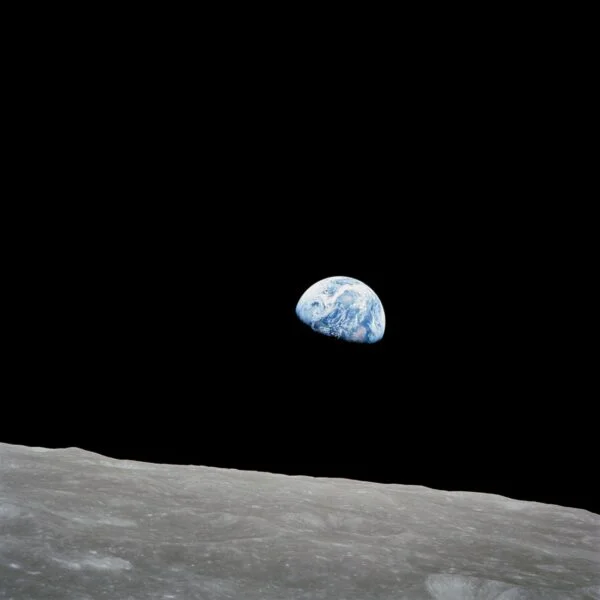
Bacon’s innovation was a slow burn, born out of curiosity, single-mindedness and commitment. After graduating from Cambridge in 1925 he worked in industry, in his spare time trying to build a stable device that would store energy in the form of hydrogen and release it as electricity.
He was building on the work of Sir William Grove, who in 1839 had demonstrated the concept of a fuel cell.
Armed with sponsorship, Bacon returned to Cambridge in 1946 to continue his research and, via a partnership with the Cambridge engineering firm Marshall, demonstrated a 6kw system in public in 1959.
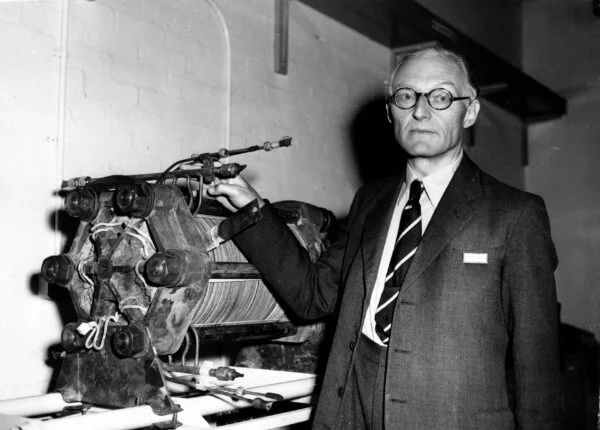
Cambridge’s Chemical Engineering Department noted this event, when the photo above was taken:
Aug. 24, 1959 – Cambridge, England, U.K. – A demonstration was held this morning of the Hydrox Fuel Cell, the invitation of Mr. Thomas Bacon, sponsored by the National Research Development Corporation, an invention which is expected to revolutionise the field of electricity. Mr. Bacon has been working on his idea since 1932. The cell does not store electricity, it makes it by chemical conversion.
The ‘revolution’ did not take place, at least not in Britain. But the American aviation company, Pratt & Whitney, saw a practical application in Bacon’s innovation: NASA’s plans to go to the Moon.
What became known as the ‘Bacon Fuel Cell’ solved the problem of generating electricity in space. The technology works by combining hydrogen with oxygen in a redox reaction – in which at least one component element loses electrons – which in turn generates an electrical current.
Interviewed by the BBC in the wake of the lunar landings, Bacon described his fuel cell as akin to a battery.
… normally a battery in course of time, it runs down, and you have to re-charge it. Now this device, as long as you keep on feeding hydrogen and oxygen into it, and you remove the water formed, it will go on generating power indefinitely – and in fact the astronauts drink the water.
Asked if he had ‘visions of space-travel’ when began his research, Bacon replied: ‘No, it never occurred to me for a moment. I always hoped it would be used for driving vehicles about – road and also rail vehicles.’
A modest man, according to the Heaton History Group, at the many awards ceremonies Bacon attended he always gave credit to the engineers at Pratt & Witney.
But, says Sam Stranks, Professor of Energy Materials and Optoelectronics at Cambridge’s Department of Chemical Engineering and Biotechnology, Bacon was ahead of his time.
Tom Bacon’s legacy is really inspiring for us in the Department. He was really the first pioneer, or among the earliest, in green energy.
He developed the fuel cell from a fundamental concept and he persevered at that concept to create a scaled, actually useable energy source that powered life support systems in the Apollo missions.
He was ahead of his time in a lot of ways. The legacy of his work continues to inspire our research today, from work on alternative fuels such as ammonia to battery technologies to solar photovoltaics.
The historian Professor Richard Serjeantson, a Fellow of Trinity College, said that though born hundreds of years apart, Francis Bacon and Tom Bacon shared similar traits – in particular their belief in the use of technology to advance human endeavour.
In Bacon’s time, Moon travel was a subject of satire, not of reality. But certainly nothing would have pleased Francis Bacon more than to know that a relative of his had been instrumental in bringing about the first actual Moon Landings.
Tom Bacon met Neil Armstong, Buzz Aldrin and Michael Collins at a reception at Downing Street after the astronauts returned to Earth.
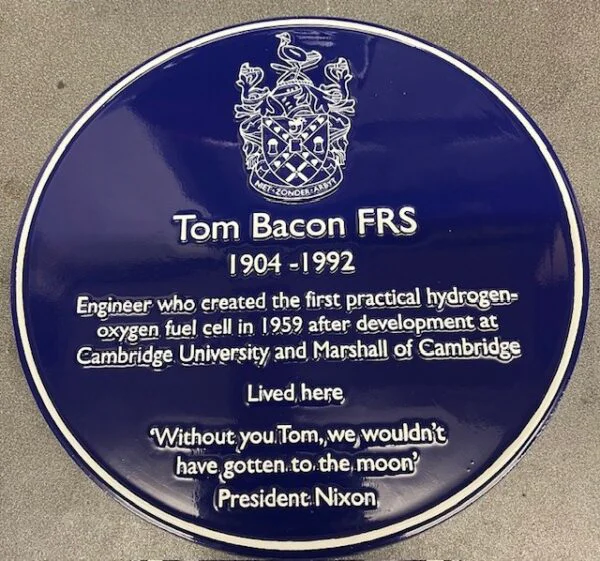
He received an OBE in 1967 and was elected a Fellow of the Royal Society in 1973. In 2024 a blue plaque, pictured above, on his former home in Little Shelford honoured his achievements.