
This month 75 years ago Bertrand Russell (1872–1970) gave his Nobel Prize speech in Stockholm. The philosopher, social commentator and political activist had received the Nobel Prize in Literature ‘in recognition of his varied and significant writings in which he champions humanitarian ideals and freedom of thought.’
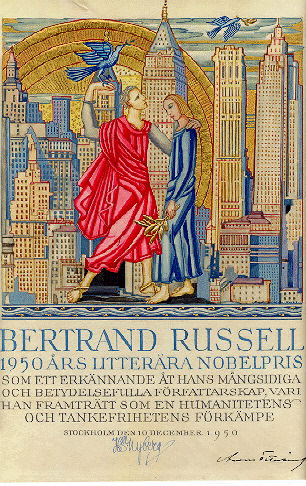
It was the 50th anniversary year of the Nobel Prize in Literature. In his presentation speech, The Swedish Academy Permanent Secretary Anders Österling paid tribute to Russell’s ‘superior intellect’, the imposing scope of his writing, and his active involvement in public debate over the past half century. He said:
What is important, from our point of view, is that Russell has so extensively addressed his books to a public of laymen, and, in doing so, has been so eminently successful in keeping alive the interest in general philosophy.
Österling cited some of Russell’s publications including The History of Western Philosophy (1946), Human Knowledge (1948) and Sceptical Essays (1948). ‘But to these should be added a great number of equally important books on practically all the problems which the present development of society involves,’ he said.
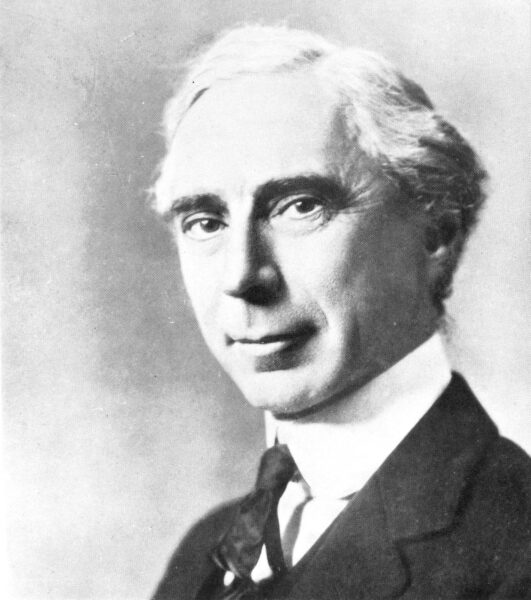
Russell had not always been so feted.
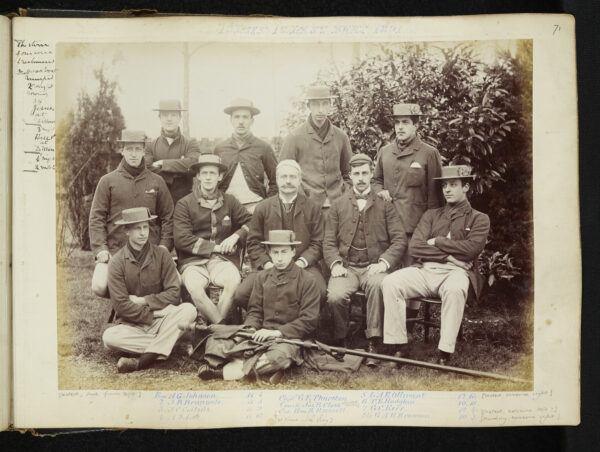
He had arrived at Trinity on a scholarship in 1890 and immediately felt at home. He studied maths and then philosophy, excelling in both. After his first Fellowship, he was made a College lecturer, a post he was dismissed from in 1916, due to being convicted under the Defence of the Realm Act for anti-war activities.
Although most Fellows were opposed to his dismissal and he was reinstated in 1919 (but resigned the following year), Russell was only elected a Fellow in 1944 and a Life Fellow in 1949.
He secured his place in the history of logic and philosophy with the publication in 1903 of The Principles of Mathematics, followed by Principia Mathematica, co-authored with Alfred North Whitehead (1910, 1912, 1913).
These were not his only academic interests, as Alexander Bird, the current Bertrand Russell Professor of Philosophy at Cambridge, explained:
While this work at the intersection of mathematics and philosophy is his most significant academic contribution, Russell was catholic in his philosophical interests and prolific in his writing, contributing important work on topics in epistemology, metaphysics, philosophy of language, and even ethics.
As well as his pacifism during the First World War, Russell’s exploration of personal matters was also controversial.
In Marriage and Morals (1929), he argued for greater freedom of opinion, action and education regarding sex and sexual morality, which challenged conventional morality and shocked many. It contributed to the revocation of Russell’s teaching appointment at the City College of New York in 1940.
But Russell was impervious to disdain, outrage or failure. He stood for Parliament (twice) unsuccessfully, supported pacifists during the First World War, campaigned for the abolition of weapons of mass destruction, and was fined and imprisoned for his anti-war and anti-nuclear activities.
Österling’s speech presenting Russell’s Nobel Prize foresaw that he was ahead of his time.
Thus, even if Russell’s work has, from a purely practical point of view, met with but little success in an age which has seen two world wars – even if it may look as if, in the main, his ideas have been bitterly repudiated – we must nevertheless admire the unwavering valour of this rebellious teller of the truth and the sort of dry, fiery strength and gay buoyancy with which he presents his convictions, which are never dictated by opportunism but are often directly unpopular.
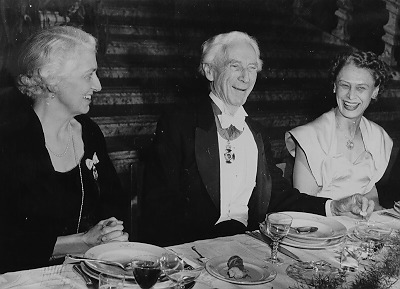
While Russell supported the Allies in the Second World War due to his disgust of the Nazis, with the dropping of the atomic bomb on Hiroshima he was immediately alert to the global peril posed by nuclear weapons.
His famous BBC broadcast of 23 December 1954, ‘Man’s Peril,’ kickstarted campaigns against weapons of mass destruction, with Russell often at the helm.
Trinity’s Wren Library has the autographed manuscript, ‘The Implications of the H-Bomb’ of this broadcast, which formed the basis of the Russell-Einstein Manifesto, released in 1955.
Russell galvanized the first Pugwash Conference, which brought together concerned scientists. In 1958 he founded the Campaign for Nuclear Disarmament, and in 1961, he was imprisoned again, this time for civil disobedience relating to anti-nuclear protests.
Professor A C Grayling remarks that he was ideally suited to public debate because of ‘four priceless assets: an extraordinary intelligence, a lucid eloquence, a broad knowledge of history, and a complete fearlessness in the face of opposition,’ (OUP 1996).
Professor Bird, speaking at the recent unveiling of a blue plaque in Russell’s honour, said:
Russell loved Cambridge and Trinity. In later life he regarded Trinity as a haven from the travails of personal and political life. As a young man, he made important intellectual and personal relationships, such as with GE Moore and Ludwig Wittgenstein – both holders of the chair that now, thanks to Trinity and other benefactors, bears his name.
The blue plaque will be installed at Grosvenor Lodge on Babraham Road, where Russell lived after he returned to Cambridge from the United States in 1944.
Organized by Cambridge Past, Present and Future, the unveiling was held in the Master’s Lodge and attended by the Master Dame Sally Davies, the Mayor of Cambridge Dinah Pounds, local councillors and members of the Russell family.
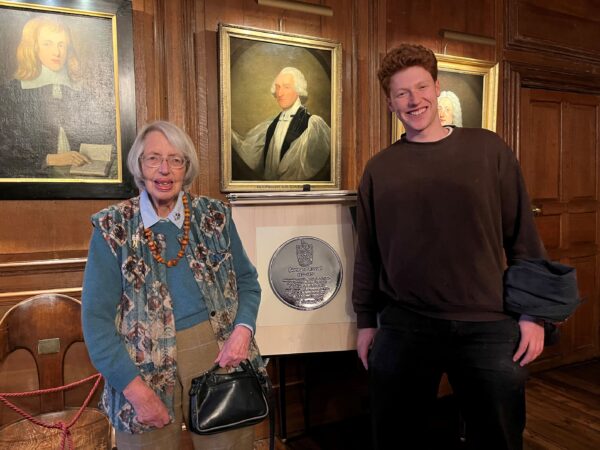
Pictured above with the plaque is Mrs Linda Yeatman and Ben, one of her two grandsons. She said: ‘Our relationships to Bertrand Russell go back to Lord John Russell, who was Bertrand Russell’s grandfather and my great-great-grandfather. So, Jacob, my other grandson, worked out that he and Ben are 1st cousins 6 times removed from Bertrand Russell, and consequently I am a 1st cousin 4 times removed from him.’
Ben, who is studying History at the University of Manchester, learnt of his relationship to the philosopher relatively recently and said it had come as quite a surprise.
Banner image: Courtesy of the Bertrand Russell Archives at McMaster University; and Trinity College Cambridge.