
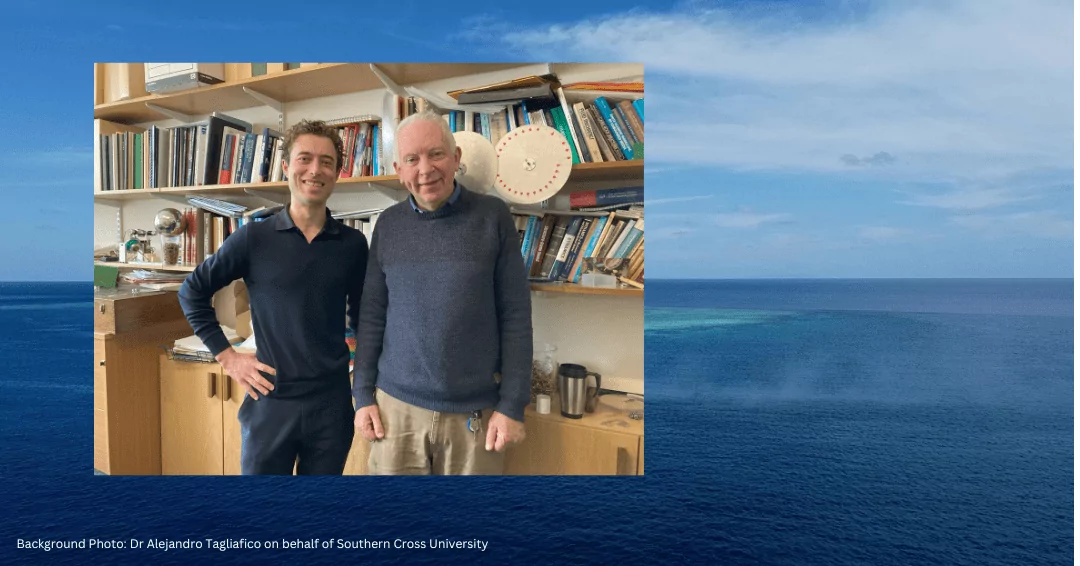
They are both Australian, studied engineering and are concerned about climate change. And that’s not all Professor Hugh Hunt and Dr Dante McGrath of Cambridge’s Centre for Climate Repair share in common.
They are committed to studying climate intervention techniques designed to mitigate the effects of global warming and halt further damage to ecosystems such as coral reefs and the Arctic.
Spraying tiny seawater droplets into marine clouds to reflect sunlight, thereby creating a cooling effect, is one such technique – known as marine cloud brightening. And it’s not just a paper dream.
Earlier this year, Dr McGrath, of Queens’ College and a member of the Trinity College Postdoctoral Society, took part in experiments over the Great Barrier Reef, testing marine cloud brightening as a technique to address coral bleaching.
Professor Hunt and Dr McGrath are investigating the same technique to address sea ice melting in the Arctic.
‘The Arctic could be sea ice free within a decade if we don’t act now and once we lose the sea ice we can’t really predict what will happen next,’ says Professor Hunt. Such ecosystems can’t wait for the world to reduce its reliance on fossil fuels and cut carbon emissions, he says.
We are about to breach the 1.5C warming threshold (outlined in the Paris Agreement, relative to pre-industrial temperatures) and we are running out of time to limit warming to 2C. This means that we’ll see increases in heat waves and floods, stress of water supplies, crop failures, forest fires, sea level rise, coral bleaching, permafrost melting, methane release …
On 7 November, Dr McGrath will pitch the idea of marine cloud brightening in the Arctic at the Falling Walls Science Summit, an annual gathering of bright minds from academia, business and civil society in Berlin.
He won the Falling Walls Lab Cambridge 2024 with a word-perfect three-minute pitch.
As a PhD student at the University of Cambridge, Dante studied fuel droplets in combustion engines – a technology causing global warming. Now at the Centre for Climate Repair he has applied his expertise to mitigating the effects of climate change by studying seawater droplets for marine cloud brightening.
Many ecosystems have suffered at the hands of climate change. The impacts felt in my lifetime motivate me to make a positive contribution and I am thrilled to be involved in climate change research at Cambridge – addressing causes, effects, and potential solutions.
While there are more questions than answers about the technology, including issues relating to governance and ethics, Dr McGrath says the potential benefits are very appealing.
‘As a complement to emissions reduction and greenhouse gas removal, techniques such as marine cloud brightening may bolster society’s toolkit to manage a future beyond 1.5°C,’ he says.
Professor Hunt, who first became interested in climate intervention in 2009, is also upbeat. ‘There are plenty of grounds for optimism so long as we recognise the inadequacy of the old paradigm of emissions reductions alone. We have to face up to the new paradigm of climate intervention.’
Find out more about The Centre for Climate Repair.
More from Professor Hunt on the Imperative for Marine Cloud Brightening.