
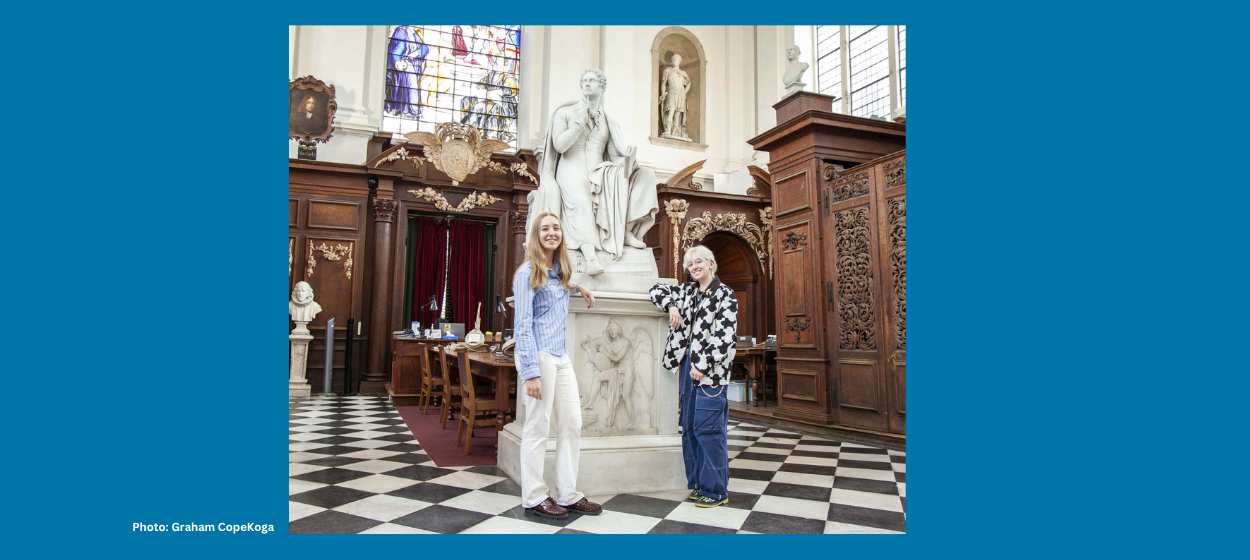
A Trinity student who researches the electrical currents of heart tissue has co-written a musical inspired by Mary Shelley’s Frankenstein, a monster brought to life by electricity.
Nat Riches from Trinity and Natasha Atkinson from Downing were intrigued by the ‘haunted summer’ of 1816, when tumultuous weather confined writers including Lord Byron, Percy Shelley and Mary Godwin (later Mary Shelley) to a villa beside Lake Geneva.
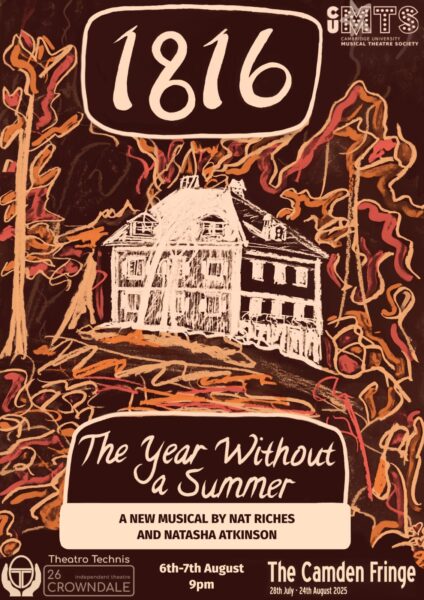
1816: The Year Without A Summer is one of two Cambridge student productions selected by the Cambridge University Musical Theatre Society for the Camden and Edinburgh Fringe festivals this summer. Nat and Natasha’s musical premieres at Teatro Technis Theatre on Wednesday 6 and Thursday 7 August.

Byron, a student at Trinity 1805-1808, became famous for his literary prowess, charisma and good looks – and notorious for his lifestyle. In April 1816 he left his wife and England, tainted by the scandal of debt and a rumoured affair with his half-sister. He would never return.
Accompanied by his personal doctor John Polidori, Byron sailed up the Rhine and entered Switzerland where he rented Villa Diodati, beside Lake Geneva, in what should have been pleasant summer weather. Holidaying nearby were Percy Shelley, Mary Godwin and her half sister, Claire Clairmont, who Byron invited to stay at the villa.
Natasha and Nat’s musical brings to life these characters cooped up in the villa by the terrible weather wrought by the huge volcanic eruption of 1815 in the then Dutch East Indies. As rain lashes down, the wind gets up and it’s dark by the afternoon Byron sets the assembled guests a challenge: who can write the most chilling ghost story?
It’s not a spoiler to say this was the genesis of Mary Shelley’s Frankenstein and John Polidori’s The Vampyre, two of the greatest horror stories of the last two centuries. But in 1816: The Year Without A Summer, there is more. Nat said:
With five strong characters and turbulent relationships, there is so much drama to uncover.
But things fall apart the longer they are stuck together, with tensions slowly beginning to fester. Tormented by their drive and isolation, the group finally splinters, leaving each character to reflect on the heavy cost of their creative ambitions.
There’s tension, there’s drama, there’s comedy. It’s all happening in the villa.
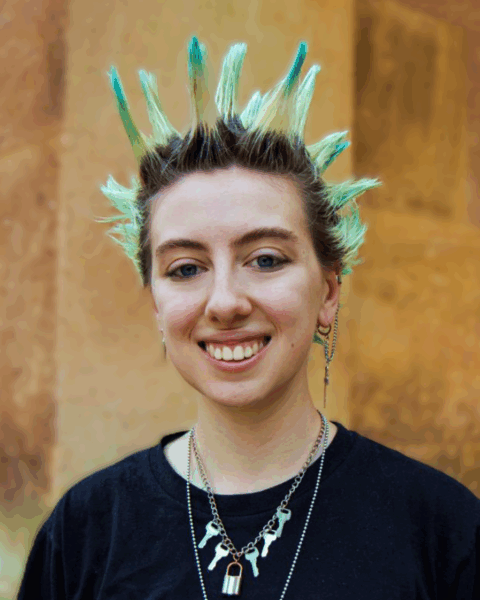
Nat, who studies Natural Sciences, and Natasha, who graduated with a Law degree in 2024, were inspired by different elements of the Romantic poets’ lives and that summer by Lake Geneva, which is captured in Polidori’s diary.
Perhaps it’s a neat coincidence that Nat was intrigued by Frankenstein, who was fashioned by a young scientist from different body parts and sparked to life by electrical currents. While writing the musical she was testing how cardiac drugs affect the electrical current in heart cells and the impacts on the structure of the cells themselves.
I’d dedicate the evening to writing the musical and then in the day I would have a break from it. I’d do my scientific work. I was in the lab, 9am to 5pm, treating my heart cell culture, pipetting, measuring things. But I’d still be mulling over ideas about the musical in the back of my head.

The writers at Villa Diodati were interested in science too, says Nat.
A lot of scientific discussion goes on during the summer of 1816. Percy Shelley is trying to discuss the connection between art and science and how you can’t value one over the other, and they must come together.
I’ve always really liked both the arts and sciences and exploring the connection between the two and showing that there really can be space for both.

Natasha was inspired by Downing College’s neo-classical architecture.
It made me think about how the Romantics were inspired by tales from Greek mythology, often weaving them into their poems.
When it came to the musical, I knew I wanted to transport the audience into the brooding world of the poets, complete with imagery from ancient myths. I wanted to suspend time for a moment, the way I feel walking around Downing and Cambridge.
The duo met at Altrincham Grammar School for Girls and have been composing musical theatre songs since GCSE. They scored top marks in A-level music and after visiting the Edinburgh Fringe ‘realised we really wanted to write something like that,’ recalls Nat.
The opportunity to study a subject intensively and pursue something entirely different in your own time is one of Cambridge’s great benefits, they say.
‘1816: The Year without a Summer’ premieres at the Camden Fringe, Theatro Technis, 26 Crowndale Road, London on 6 & 7 August at 9pm, followed by a run at the Lion and Unicorn Theatre, 30 September to 4 October. The show will return to Cambridge and the Corpus Playroom in October 2025.