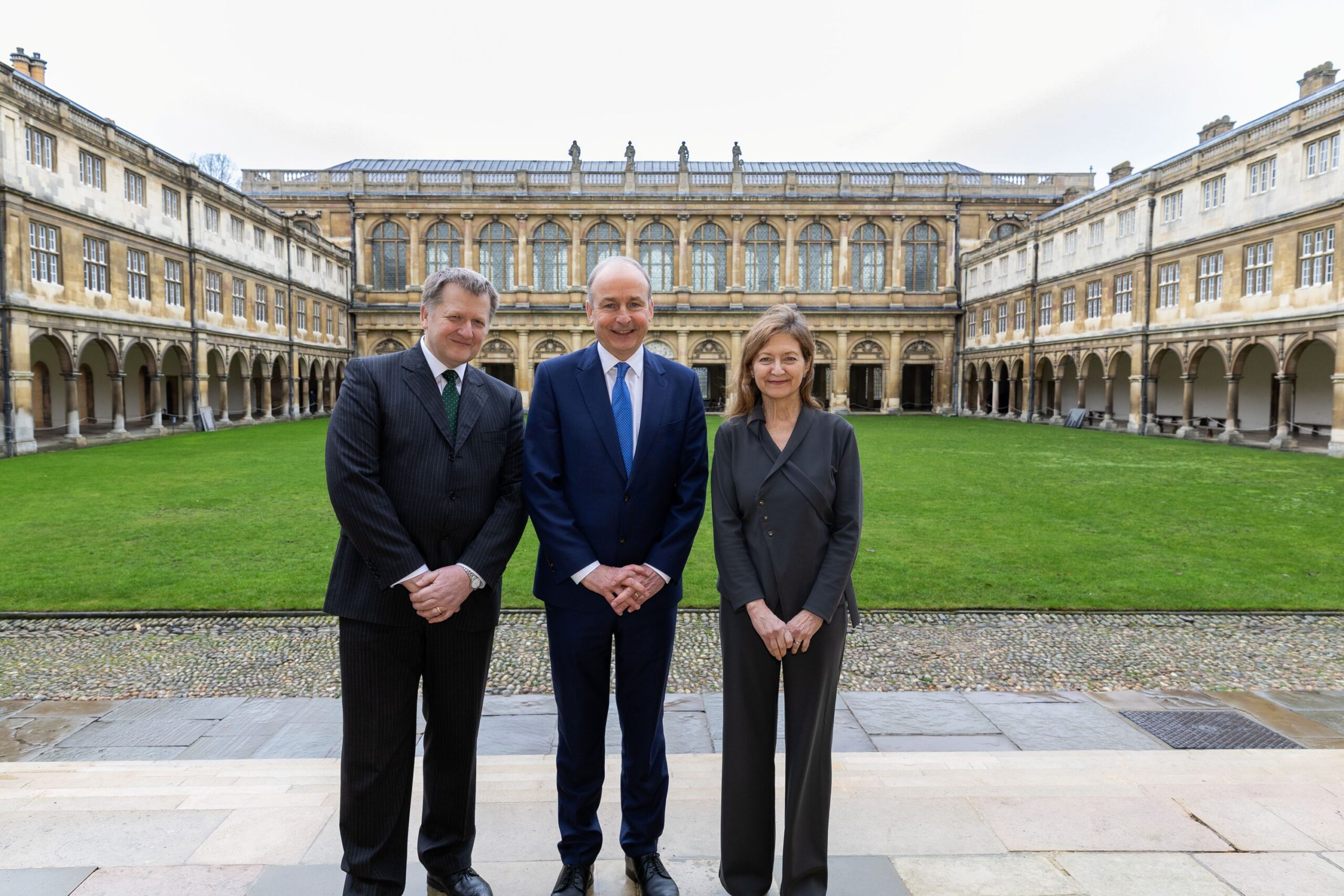
The Taoiseach of Ireland Micheál Martin announced that Professor Alvin Jackson will be the first Childers Professor of Irish History at Cambridge during a celebration in Trinity’s Wren Library.
The new Professorship was created thanks to a gift of £3.6 million from the Government of Ireland, reflecting Ireland’s commitment to Irish history at Cambridge and to building closer academic ties between Ireland and the UK.
The post is named in recognition of Robert Erskine Childers and his son, Erskine Hamilton Childers, both alumni of Trinity College Cambridge and significant figures in modern Irish history.
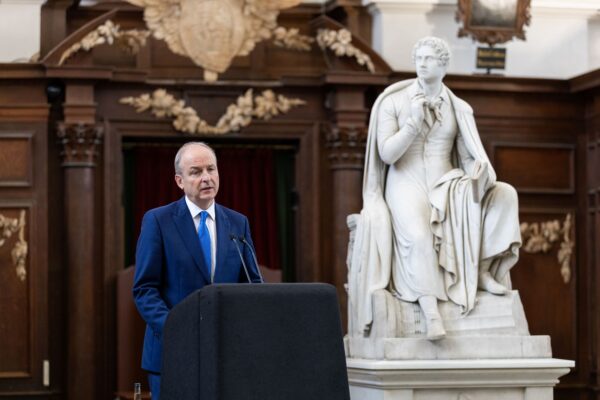
The Taoiseach (Prime Minister) said funding the the new academic post demonstrated the Irish Government’s belief in the power of higher education and the importance of historical scholarship in protecting democratic values.
I am delighted to be in Cambridge today to mark the establishment of the Childers Chair of Irish History in Trinity College. This is a time when we need to protect and strengthen bonds between our countries. It is a time when we need to assert the importance of diverse, rigorous and independent historical scholarship. It is a time when we should do more to honour figures who can challenge us to see the richness and complexity of our past.
In welcoming the Taoiseach, the Vice-Chancellor of Cambridge Professor Deborah Prentice said his visit provided an opportunity to demonstrate the University’s strong commitment to academic collaboration between the UK and Ireland and to highlight the University’s extensive work on Irish history.
Professor Alvin Jackson, who has been Richard Lodge Professor of History at Edinburgh University since 2005, said:
Cambridge has had a long tradition of researching and teaching Irish history, and of addressing the complexities of the British-Irish relationship. I’m honoured both by the opportunity to contribute to this tradition – and by the invitation to join the current, distinguished community of historians at Cambridge.
Professor Lucy Delap, Chair of the Faculty of History at Cambridge, said: ‘This significant gift to the History Faculty will place Irish history at the forefront of our work. The Childers Professor will offer historical perspectives on pressing issues today in British/Irish relations and Ireland’s wider global relationships.’
After the speeches the Taoiseach and guests viewed a special exhibition including letters by Erskine Childers, which was curated by Trinity’s Librarian Dr Nicolas Bell. The Taoiseach said the new professorship was a fitting memorial to the Childers – ‘personalities who deserve our respect, and they reward our engagement.’
They were both members of the Anglican faith who were born and educated in England. This included taking degrees here in Trinity. Neither of them was a cultural nationalist, holding a broader view of what defined a nation. They also both married exceptional women, whose spirits and intellects were undeniable.
They ultimately speak to the remarkable complexity and interconnections which you find within Irish society and in our links with Britain. They are a reminder that you cannot understand Irish history if you try to impose crude assumptions about religion or class.
The commemoration of the Childers through the endowment of a professorship in modern Irish history is, I believe, a fitting memorial from a grateful state to their spirit and an invitation for us to look deeper into Irish history.
Read the Taoiseach’s announcement of the first Childers Professor of Irish History at Cambridge.
Watch Cambridge History Faculty’s Youtube of the ceremony.
Banner photo: Professor Alvin Jackson, The Tsaoieach Micheál Martin and Professor Deborah Prentice. By Nick Saffell/Cambridge University.
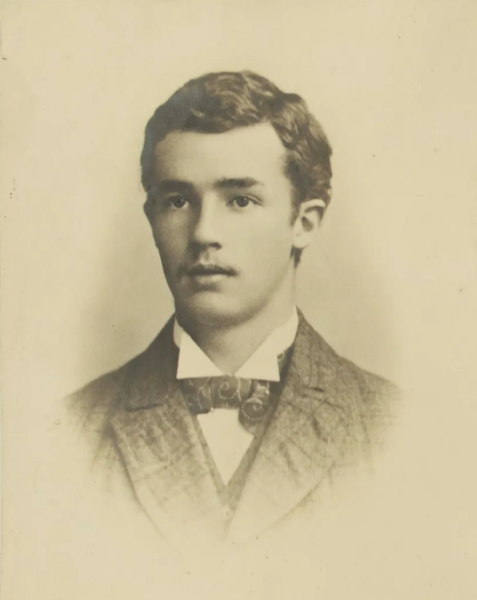
Who was Erskine Childers?
Robert Erskine Childers (1870-1922) was a writer, sailor and soldier who became a leading figure in the struggle for Irish Home rule.
Born to an Anglo-Irish mother and Orientalist-scholar father, brought up in Ireland and educated in England, Childers served in the Boer War and was decorated for his service in the First World War.
His transition from supporter of the British Empire to the nationalist cause and then ardent republicanism was gradual, shaped by friends, his wartime experiences and the views of his American wife Molly.
Childers was admitted to Cambridge in 1889 to study Classics and staying an extra year to study Law. He threw himself into College life, rowing in the second boat, editing the Cambridge Review and becoming Vice President of Magpie & Stump, the College debating society.
Soon after graduation, Childers became a clerk in the House of Commons, which he combined with sailing adventures and volunteering with the Honourable Artillery Company. In 1898 he enlisted to serve as a driver in the Boer War until his unit was returned to England in 1900.
In 1903 Childers published The Riddle of the Sands, a highly realistic novel about a German invasion of England, which is regarded as the first espionage novel and was favourably reviewed. A copy inscribed by Childers and given to his close friend at Trinity, Ivor Lloyd-Jones, is held in the Wren Library.
Childers married Molly Osgood, of Boston, in 1904. A fervent republican, she was to have a crucial influence on her husband’s political outlook. Although he fought and received the Distinguished Service Cross for his service in the Navy and RAF, Childers’s politics had been changing and before the end of the First World War he was a convert to the cause of Irish Home Rule.
In 1919 he moved permanently to Ireland, committing himself fully to Irish independence and getting involved with the self-declared Irish Government.
After the Irish War of Independence of 1921, he was part of the delegation sent to negotiate peace terms with the British Government. Childers opposed the Anglo-Irish Treaty because it failed to achieve a fully independent Irish Republic. In the bitter divisions and outbreak of civil war that followed, Childers used his writing skills to support the Irish Republican Army.
After being captured by Free State forces, Childers was charged under emergency legislation and tried by a military court for unauthorized possession of a revolver. He was shot by firing squad on 24 November 1922 and buried at Beggars Bush Barracks. A year later his body was reinterred in the Republican Plot in Glasnevin Cemetery.
Shortly before his execution one of his two sons, Erskine Hamilton Childers, was allowed to visit him in prison where his father asked him to bear no bitterness towards his political opponents.
Two years later Erskine Hamilton came up to Trinity to study history, graduating in 1929. Like his father, he also became an Irish citizen, then entered politics, becoming President of Ireland in 1973.
Trinity College holds the papers of Erskine Childers which include correspondence, printed material, writings, personal papers, and photographs documenting his life in England. Find out more: “It doesn’t matter what you think of me. I know you love me-” – Erskine Childers’ goodbye – Trinity College Library, Cambridge