
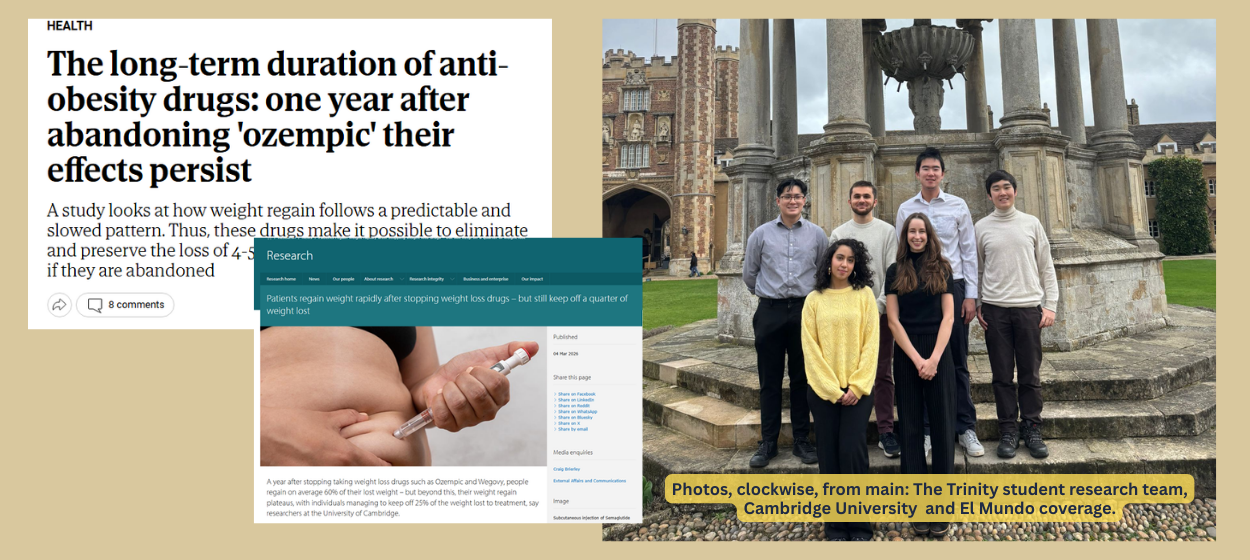
Newly published research by Trinity students Steven Luo, Brajan Budini, Issy Stead, Andrew Lee, Angelica Akrami and Martin Tam suggests that patients who stop weight-loss medication could keep off 25% of the original weight lost.
Stories of rapid and significant weight loss resulting from drugs such as Ozempic and Wegovy have been replaced recently by concerns about substantial weight regain after patients stop taking the medication.
The Trinity students’ research reveals a more complex picture, with weight regain plateauing at 75% of original weight loss – suggesting that 25% of weight loss could be sustained long term.
Their research – which reviewed existing medical literature and pooled the results of multiple studies – allowed them to model the trajectory of weight regain, up to and beyond 52 weeks.
The research has been published in eClinicalMedicine and covered extensively by media including BBC Radio 4’s Today Programme, Sky News, The Guardian, The Telegraph, The Independent, The Daily Mail, The Mirror, The Sun and The Express, as well as Die Welt and El Mundo.
The researchers cautioned that concerns remain about the consequences of weight-loss drugs on the body – including whether more fat or muscle is lost – and what happens during weight regain.
Fifth-year medical student Brajan Budini said:
Our projections show that even though people regain most of the weight they have lost, they still maintain some of the weight loss, but what we currently don’t know is if the same proportion of lean mass is recovered. If the regained weight is disproportionately fat, individuals may ultimately be worse off than before in their fat-to-lean mass ratio, which may have adverse consequences for their health.
Director of Studies in Medicine at Trinity, Professor Rebecca Fitzgerald said she was delighted with the students’ achievement.
Cambridge equips and encourages its students to embrace challenge both within and beyond their studies. At Trinity, we have medics who are teaching the next generation of doctors, treating hospital patients, and conducting research that will improve healthcare and people’s lives.
It is fantastic to see our medical students seeing an opportunity where their skills can be put to good use, working as a team to research an important issue and delivering high-quality data for publication in a leading medical journal.
Ultimately this will help people make informed decisions about their health and is testament to the remarkable ‘Trinity ecosystem’ that makes Cambridge and the College such a brilliant learning environment.
‘We believe this fits the Cambridge medical ethos of taking our learning further in a spirit of enquiry’ – Trinity medical student Andrew Lee
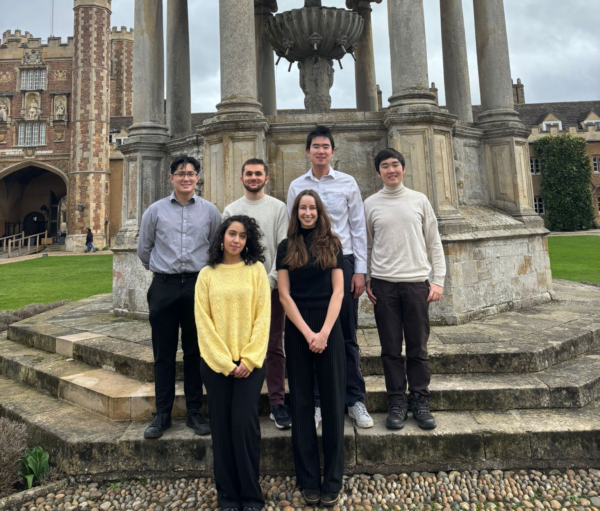
The Trinity team Steven Luo, Brajan Budini, Issy Stead, Andrew Lee, Angelica Akrami and Martin Tam explain the genesis of the project, how they collaborated and what they learnt from the process.
Whose idea was this research?
Steven Luo: Brajan initiated this project with the aim of reviewing outcomes after stopping semaglutide, noting that the research in that area was underexplored. We noticed that while many trials focused on weight loss during treatment, far less attention was paid to what happens after stopping these medications, despite this being a common real-world scenario. After discussions within our group about the state of the literature, I suggested expanding the study to the new generation of weight-loss drugs that target a protein (which are known as GLP-1 Receptor Agonists) to increase our evidence base while maintaining a coherent focus.
What sparked your interest in this area?
Brajan Budini: GLP-1 Receptor Agonists, such as Ozempic and Mounjaro – which help control blood sugar and reduce appetite – have caught everyone’s attention, including our own, as they have substantially reshaped how obesity is managed using drugs. However, major international clinical trials have demonstrated significant weight regain following treatment discontinuation. At the same time, real-world evidence indicates that more than 50% of patients discontinue the drugs after one year, for a range of reasons, including cost and side effects. Taken together, these findings suggested that weight regain presents a real risk to patients who rely on such drugs for weight management. This prompted us to investigate weight regain further, in an attempt to understand its trajectory across time and whether there may be factors that could mitigate weight regain following treatment discontinuation.
How did you all work together?
Issy Stead: Preclinical medicine at Trinity has a strong academic component which was challenging at times. Supporting each other through those years is where our friendships took shape. Alongside being friends, we grew into academic colleagues; we trusted one another to produce rigorous, high-quality research. During the project, we met weekly and balanced the work alongside our studies – staying motivated felt much easier because everyone was committed and working hard. As medical specialty training increasingly requires us to be strong scientists as well as clinicians, projects such as this allow us to learn from one another and make ambitious research feel achievable. I am deeply grateful for the friends I have made at Trinity, and for everything we have been able to achieve together.
Was the project part of your studies or extra-curricular?
Andrew Lee: While the Cambridge medical curriculum encourages research, this work has been almost entirely extra-curricular. Our project quickly evolved into a larger effort – involving significant amounts of time planning, screening, data analysis, writing and meetings. We also took time to prepare for external meetings, including the British Pharmacological Society’s 2025 conference (Steven and Andrew) and the Nutrition Society’s 2026 Winter Conference (Brajan). We plan to present at the 2026 conferences of the Society for Endocrinology (Isabel). We believe this fits the Cambridge medical ethos of taking our learning further in a spirit of enquiry.
To what extent did the finding surprise you or meet your expectations?
Angelica Akrami: The findings were very much in line with what I expected. It made sense that if a patient were to stop GLP-1 Receptor Agonists, they would gain weight again. However, it is perhaps useful for the public to be aware of this, as there seems to be a misconception that taking such drugs is a permanent solution to weight management.
Steven Luo: It was also interesting to see that patients on average maintain some level of weight loss as opposed to regaining everything.
What do hope your research will achieve?
Martin Tam: We hope this research helps set realistic expectations about weight-loss drugs like GLP-1 Receptor Agonists. While they can be effective tools, they are not a cure for obesity or a solution that works without personal effort. By showing that weight regain after stopping treatment follows a predictable pattern rather than representing failure, this work aims to correct the idea that these drugs are a permanent fix. Instead, it highlights their role as one part of a broader, long-term approach to health that includes lifestyle change, ongoing support, and informed decision making between patients and clinicians.
Reference Budini, B & Luo, S et al. Trajectory of weight regain after cessation of GLP-1 receptor agonists: a systematic review and nonlinear meta-regression. eClinicalMedicine; 4 Mar 2026; DOI: 10.1016/j.eclinm.2026.103796