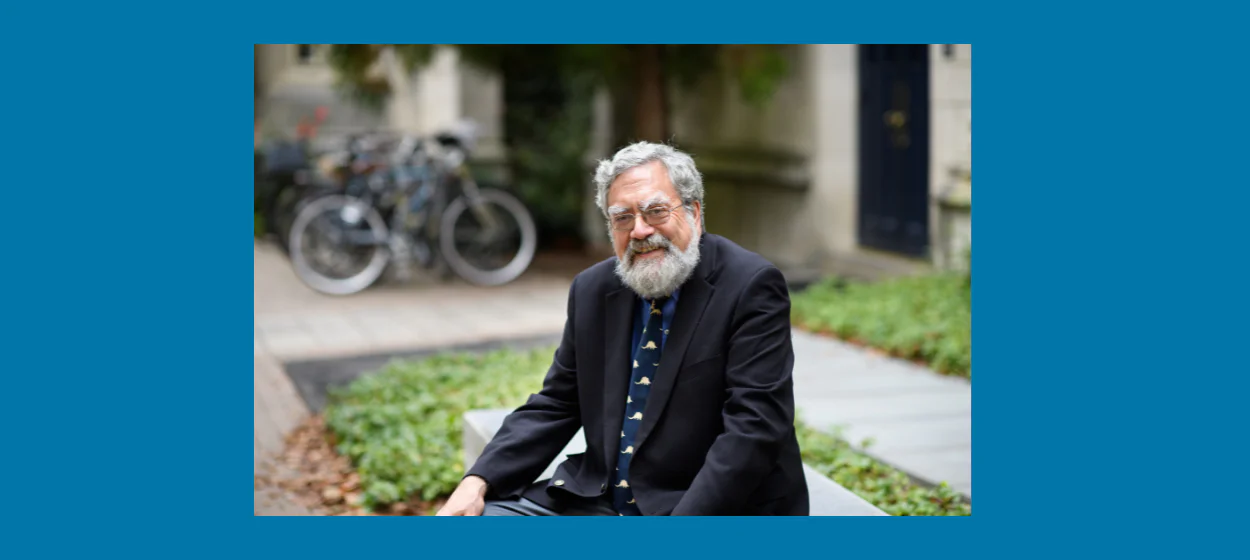
The Henry Putnam University Professor of History, Emeritus, Anthony Grafton will give Trinity’s 2026 Birkbeck Lectures on Ecclesiastical History in Early Modern Europe: Forms, Practices, Contexts, beginning on 20 October.
Here Professor Grafton shares his thoughts on the historical figure he would most like to meet, his fascination with devils and angels, what the history of education can teach us, and why ‘Profs and Pints’ sessions offer hope for the humanities.
What will you talk about at this year’s Birkbeck Lectures?
I’ll talk about the ways in which scholars and others in fifteenth- and sixteenth-century Europe tried to understand the early history of Christianity: what sorts of historical questions they asked, what sorts of evidence they analyzed, and how they tried to portray the first Christians and their world. The history of the church was attracting a great deal of attention even before the Protestant Reformation broke out. Once modern Christians realized that they disagreed fundamentally about doctrines and practices, the nature of early Christianity became an even more urgent question.
What figure from history what you most like to meet and what questions would you ask him/her?
I would most like to meet Desiderius Erasmus. I would have a long list of questions for him: above all, how he thought his way out of so many accepted doctrines. Like the present pope, he seems to have been very skeptical about theories of just war. I would want to ask him about his views on Christianity, warfare, and violence and how they developed. Even more, I would like to ask about his distinctive ways of interpreting texts: how he developed them and how far he thought others adopted them.
Why are you interested in angels and devils?
Who isn’t? For years, my colleague Jennifer Rampling (who took her PhD at Cambridge and spent some years there as a research fellow) and I had been discussing John Dee, who was acquainted with a fair number of both angels and devils, and wishing we knew more about them. For example, we knew the name of Lundrumguffa, the devil he chased out of his study in January 1582, as we learned from a marginal note by him on one of his books, now in a library in New York. But we had no idea what sort of a being Dee imagine.
More generally, we wanted to know much more about the vivid and varied ways in which early modern people imagined these beings, visually and otherwise. One of the best ways to learn about a subject is to teach a course about it, and that’s what we did – a seminar, populated by very engaged undergraduate and graduate students, with whom we read and discussed everything from Jewish and early Christian ideas about angels and devils to Milton’s portrayal of them in Paradise Lost. We still don’t know if a devil really left the burn mark still seen in a table at what is now Chetham’s Library in Manchester, where Dee wound up, but we know what that devil might have looked like.
You have said you never use your own books in your classes. Why?
History is always provisional. Good carpenters in America always say that they do their best, but there’s always something left for the next carpenters. The same is true of historians. If we’re lucky, we have colleagues who share our interests, and in time our work interests junior historians. As these scholars work their way into the sources, they see our blind spots and errors and reinterpret everything in different ways. As a teacher, I always found it best to present my own ideas, and some of the evidence I drew on, and have the students read other, differing versions. My hope was to make them both informed and independent.
What do you gain from researching historical figures who you instinctively don’t like?
It stretches your historical imagination. Joanna Weinberg, an old friend who taught Hebrew at Oxford, and I wrote two books together on Christians who studied Hebrew – Isaac Casaubon, a man of great decency as well as great learning, who treated a Jew who taught him how to read the Talmud very humanely when he fell into great trouble, and Johann Buxtorf, a far better Hebraist than Casaubon but a far spikier and less pleasing person. We had to work very hard to develop any sympathy for Buxtorf, and as we did so, we came to understand the whole landscape of Hebrew studies in early modern Europe in a new way.
What lessons does the history of education offer students today?
A great Austrian scholar who voluntarily quit his professorship in Germany when the Nazis took power, Otto Neugebauer, used to say that there was only one historical lesson: no system of education known to humanity is capable of ruining everyone. I think that’s true, but I also think we can learn more. For example, it we examine the curriculum of Oxford and Cambridge in the later Middle Ages, it looks completely, even astonishingly, academic: a deep dive for students and their teachers into highly technical issues about everything from inference to natural philosophy, much of it without an obvious practical application. Yet many medieval graduates of both universities had excellent careers in both the church and the state.
That story might suggest that today’s pundits exaggerate when they urge students to study highly practical subjects that will lead directly to employment. More than half a millennium ago, employers looked for people with sharp minds rather than internships (which didn’t exist) and model slide decks (ditto). I suspect some employers today may see their needs similarly.
Which of your books are you most proud of and why?
Mostly I wake up at night remembering particularly gruesome misprints and errors in them. I’m quite proud of an article that I wrote in collaboration with a Cambridge don, Lisa Jardine, which did much to open up the now populous field of history of reading, and of a recent book on Renaissance excavations of antiquities, that I wrote in collaboration with a German friend who teaches at Kiel. In both cases, entering a new field and working with a sharp, critical and independent collaborator made me a better historian.
Which period of history would you liked to have lived in (as well as our own) and why?
I wouldn’t want to live in any period that didn’t have modern dentistry and optometry. Apart from those mundane concerns, though, I would have liked to live in the twenties and thirties of the last century, and to have experienced the explosions they experienced in science, scholarship, and the arts – and the mobilization, heartbreakingly slow and weak at first, for a necessary if terrible world war.
How will the humanities survive?
I can only discuss my own preserve, history. There’s no lack of two vital resources: many brilliant young people love the field and would love to spend their lives in it, and many readers love history and buy surprisingly serious books. The perils are great – everything from costs to demanding funders (in the States) to those administrators – happily not all of them, though they are everywhere – who follow innovations like AI with the passion and lack of discrimination of cats after catnip. But the humanities have survived worse conditions.
I’m always heartened when I do a Profs and Pints session in an American city. They hire a bar with a performance space, advertise, and you sit amid the drums of the band that will play later on and tell 100 or 150 people, everyone from grad students to grandpas (of whom I am one) about a historical subject while they drink beer (in moderation, normally). The talk lasts three quarters of an hour, the discussion often goes longer, and often some stay after that for a beer and burger with the speaker. A lot of people who have no professional stake in history still love it, and I can’t believe the subject will collapse while that’s true.