
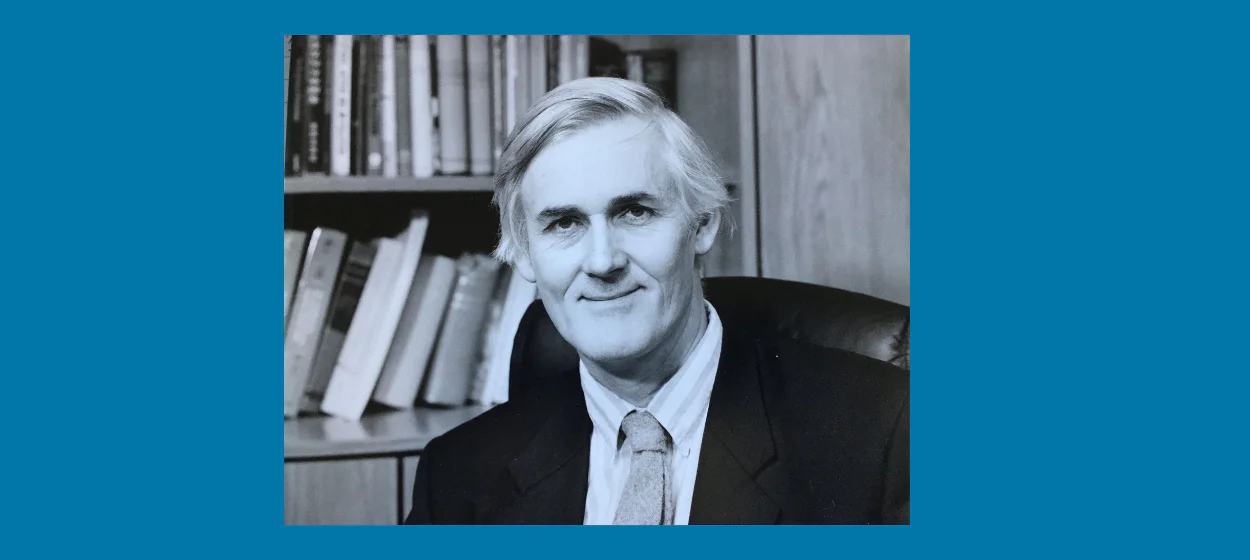
Tributes have been paid to Trinity Fellow Lord Hunt of Chesterton CB, FRS, who died on 20 April 2026.
Julian Hunt (1941- 2026) was an internationally respected climate scientist who stepped down from his role as Professor of Fluid Mechanics at Cambridge to become Director General and Chief Executive of the British Meteorological Office,1992-1997.
He was Professor of Climate Modelling at University College London and held Visiting Fellowships at leading universities.
In 2000 Julian was created a life peer as The Baron Hunt of Chesterton and sat as a Labour peer until October 2021.
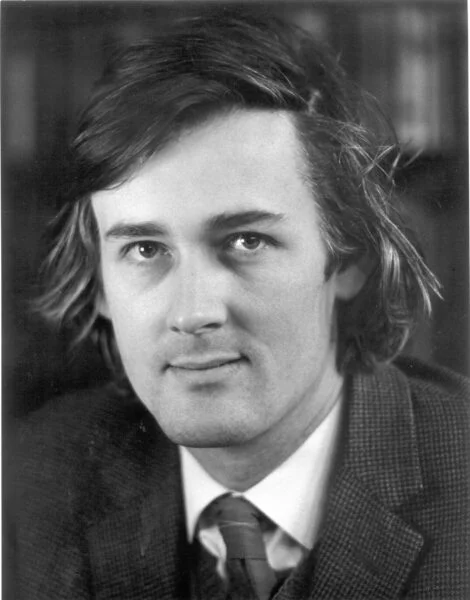
At Trinity College and the Department of Applied Mathematics and Theoretical Physics, 1963-1967, Julian Hunt completed his PhD in magnetohydrodynamics – the interaction of a magnetic field with the flow of a liquid metal such as mercury (which was used in laboratory experiments at the time).
His first job was with the Central Electricity Generating Board, where he made two significant contributions.
The first was to add large plastic balls to long stretches of power lines in order to prevent them clashing in high winds.
Julian then investigated why three cooling towers at the Ferrybridge C Power Station had collapsed in the 80mph winds of November 1965. He studied the distortion of turbulence and calculated the resulting extremes of force distribution in the towers.
Although the massive concrete structures had been built to withstand high winds, Julian discovered the effects of clustering cooling towers together: vortices shed from the first tower intensify when wrapping round a subsequent tower, so exerting stronger forces than the towers had been designed for.
Fortunately, those working on the Ferrybridge towers were taking a tea break, so no-one was hurt.
Julian’s work on the distortion of turbulence led him to develop what is known as ‘rapid distortion theory’, applicable whenever a turbulent wind is distorted by any large obstruction in its path, such as a building complex or a group of skyscrapers. It also applies to wind flow over hilly terrain, where atmospheric effects come into play.
Trinity Fellow and Emeritus Professor of Mathematical Physics Keith Moffatt said:
Julian published many influential papers in this field from 1970 on; this work established his wide reputation in meteorology and led to his appointment as Director-General and Chief Executive of the Met Office from 1992 till 1997. During this period, the effects of climate change were becoming increasingly recognised.
Julian’s scientific investigations were characterised by great flare and originality, bold assumptions, and deep physical intuition, enabling him to make progress in the ever-challenging field of turbulence, in both meteorology and ground-based engineering projects of great practical importance.
While at the MET Office, Julian Hunt encouraged the commercial application of meteorological research and worked to improve the sharing of climate data between countries. As co-founder and chair of Cambridge Environmental Research Consultants, he was responsible for the production of climate-modelling software that is widely used today.
After retiring from the Met Office, Lord Hunt returned to his subject of his PhD in the context of thermonuclear fusion research and became an advocate for the Spherical Tokamak for Energy Production initiative.
‘The severe engineering problems in realising this project, which is a central ingredient of UK energy strategy, involve the sort of MHD for which Julian’s extended experience was highly relevant,’ said Professor Moffatt.
Professor of Engineering Dynamics and Vibration Hugh Hunt first met Julian in 1990 as a newly elected Fellow of Trinity. He said:
For more than three decades Julian has helped me enormously to understand the complexity of clouds. When he was director of the MET Office, he complained that we didn’t know whether clouds caused warming (acting as a blanket) or cooling (acting to reflect sunlight).
Understanding clouds, he said, was the next critical step in climate science. In recent years he has been a great supporter of our Centre for Climate Repair and one of our big projects is Marine-Cloud Brightening where we try to enhance the reflectivity of clouds.
Bumping into Julian regularly at lunch was wonderful. We would chat for ages over coffee and bouncing ideas off each other was very productive. I will miss our interactions enormously.
Banner image, courtesy of the Hunt family.