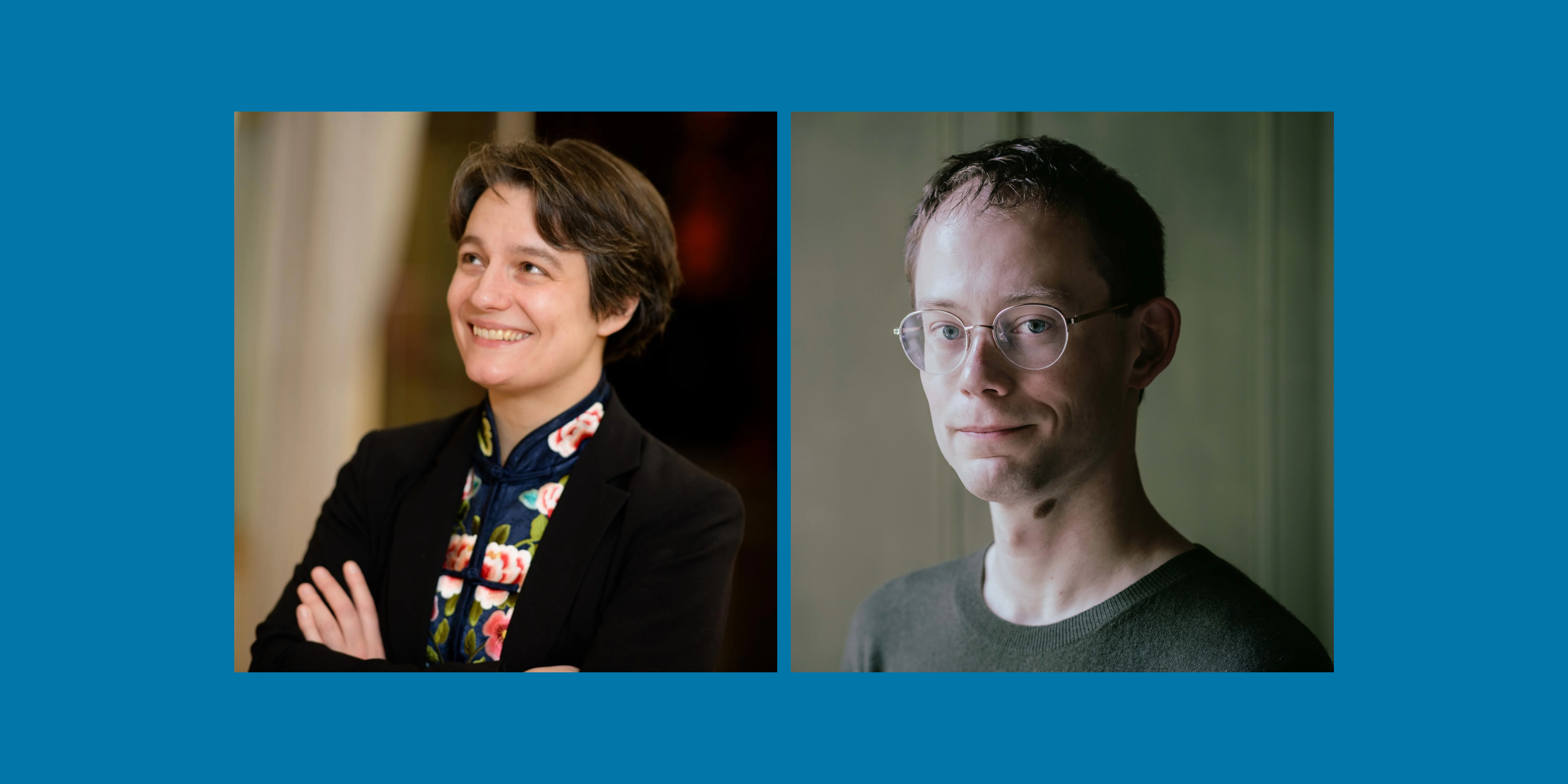
Trinity has appointed two Fellow Commoners in the Creative Arts beginning in the academic year 2026: poet Abigail Parry and composer Miles Walter. Below they tell us their plans for their two-year fellowship at Trinity, what inspires them and what they are most proud of.
ABIGAIL PARRY
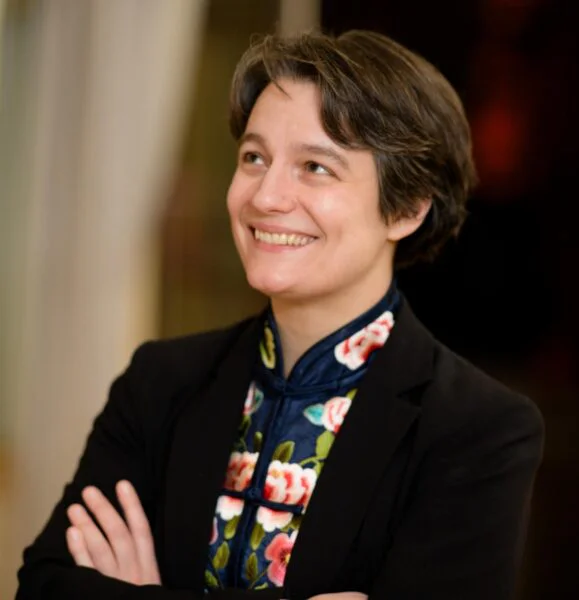
I’m a British poet, on loan from Cardiff University. I’ve written two collections to date, Jinx and I Think We’re Alone Now, both published by Bloodaxe. Jinx deals in trickery and gameplay; I Think We’re Alone Now attempts to analyse the idea of intimacy. Both have been described as knotty, and I think that’s fair. Like most writers, I have a complicated relationship with control, so I’m often tying myself up or otherwise hoodwinking myself.
What plans do you have for your time here?
I’ll be working on a verse novel about sea voyage and shipwreck. I’ve been preoccupied with this story and its characters for a while now, but just haven’t had the time to get the thing down.
I’ll also be working on a book of twenty-six short essays on Tourette’s Syndrome. Descriptions of Tourette’s tend to focus on the spectacle of ticcing, rather than on the complex web of premonitory urges, fascinations, superstitions and improvisations which prefigure the tic, and which make up the ticcer’s inward life. So I’ll be trying to find some fun metaphors for these things.
Beyond an income and place to live, what does the role of Fellow Commoner in the Creative Arts mean to you?
More than anything, it means time. Time and a bit of mental hush. I have strategies for working on individual poems between and around other things, but the long work of sustaining a narrative is different, and new to me. I’m not someone who can nip fluently between the attention needed to tell a story and the attention you must bring to your social and professional life, so a chunk of time is an incredible gift. And access to some of the best libraries in the world is really exciting.
Who inspires you?
It’s more usually what than who. I’m prone to fixating on things, and writing is a necessary reconciliation – a way to exert some control over things that would otherwise control me. Enduring fixations include pop lyrics, shipwrecks, the rules of games, arcane sign systems, various antique movie genres. These frequently turn up in my poems in some form or other.
I’ve come up against this question recently, researching the book of essays. I’m trying to find rhymes for the Tourettic experience in unlikely places: rhymes that will mean something to a non-ticcing reader. So far I’ve found what I’m looking for in the physical comedy of Buster Keaton, the convolutions of Borges’ fiction, the poems of John Ashberry. Also with baffled ticcer and alphabet-botherer Dr Johnson. I’m fairly certain my eudaemon is some sort of cross between Dr Johnson and Mimsy Farmer in Four Flies on Grey Velvet.
What are you most proud of?
I have far better friends than I deserve. I’m regularly chastened by this fact, but I’m also enormously proud of them. It’s complicated.
What do you hope to achieve at Trinity?
I’ll be happy if there are words on the page.
MILES WALTER
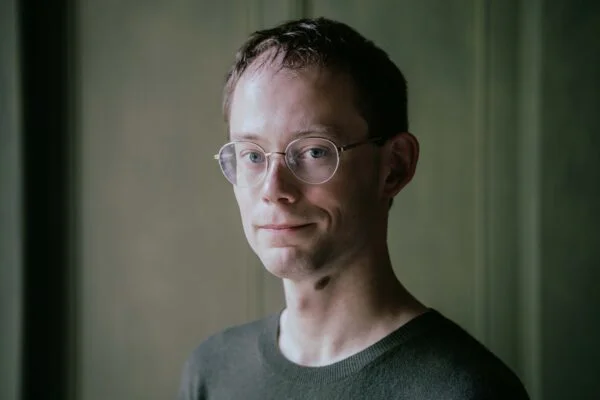
I’m a composer and pianist. I was born and grew up in a small town in New Hampshire, in the US, and then studied at Yale before moving to New York. More recently I’ve been a PhD student of Sir George Benjamin at King’s College London. I play in numerous styles; I write music mostly for classical ensembles (soloists, voice, chamber ensembles, orchestras). My hope is to write opera, sooner rather than later.
What plans do you have for your time here?
I have a large song cycle for NYC-based Argento Ensemble, an hour-long monodrama. I’ll finish off a 25′ piano quartet, and some other shorter chamber music scheduled for premiere in the next two seasons. Further I’ll finalize some revisions and record an album of my solo piano works to date, about an hour of music.
I also plan to be involved in the musical life of the College – I’ll hope to host concerts and chamber music gatherings, and of course I look forward to hearing from undergraduates about their composition work and musical projects.
Beyond an income and place to live, what does the role of Fellow Commoner in the Creative Arts mean to you?
It feels like the gift of time. It’s not always easy to maintain all the activities I insist on – composing, performing at the highest level I can, teaching, reading and listening widely, writing, trying to keep up friendships worldwide – and being offered this role feels like the kindest external confirmation that perhaps after all I’m doing what I should be doing. It feels like being entrusted with time. I’m really beyond grateful, it’s the greatest of gifts.
I’m also eager to be surrounded by world-class scholars in so many different disciplines – I miss the wildly interdisciplinary community I was part of as an undergrad, and I know I won’t be able to help but gain from unexpected connections made in conversations across fields.
I’m hesitant to expound too lengthily on what the role means to me before I begin (I’ve spent a grand total of two hours in Cambridge in my life so far)! But – finally – I additionally feel a duty to represent my field well: to demonstrate to the undergrads what giving one’s life to music can look like, and to give something back to the College community as a musician.
Who inspires you?
Anyone who makes me laugh, smile, or learn a little. And anyone who lives life in a large way.
What are you most proud of?
I find there are a lot of little moments – among other musicians, especially – when I feel proud to be a musician. I’ve often found musicians better than the norm at making and maintaining community across typical boundaries of nation, age, race, gender, background – and I find this an admirable and gratifying way of being in the world. Furthermore I’ve learned from so many musicians older than myself who retain an almost childlike openness to learning – and this is something I wish for myself always, as I continue to grow older.
What do you hope to achieve at Trinity?
My hope is to write some music I haven’t imagined yet, and find something new. ( … and perhaps finally find time to learn the Goldbergs, and the rest of Unsuk Chin’s etudes – and to truly study the Bartók Quartets, and … the list never ends.)