
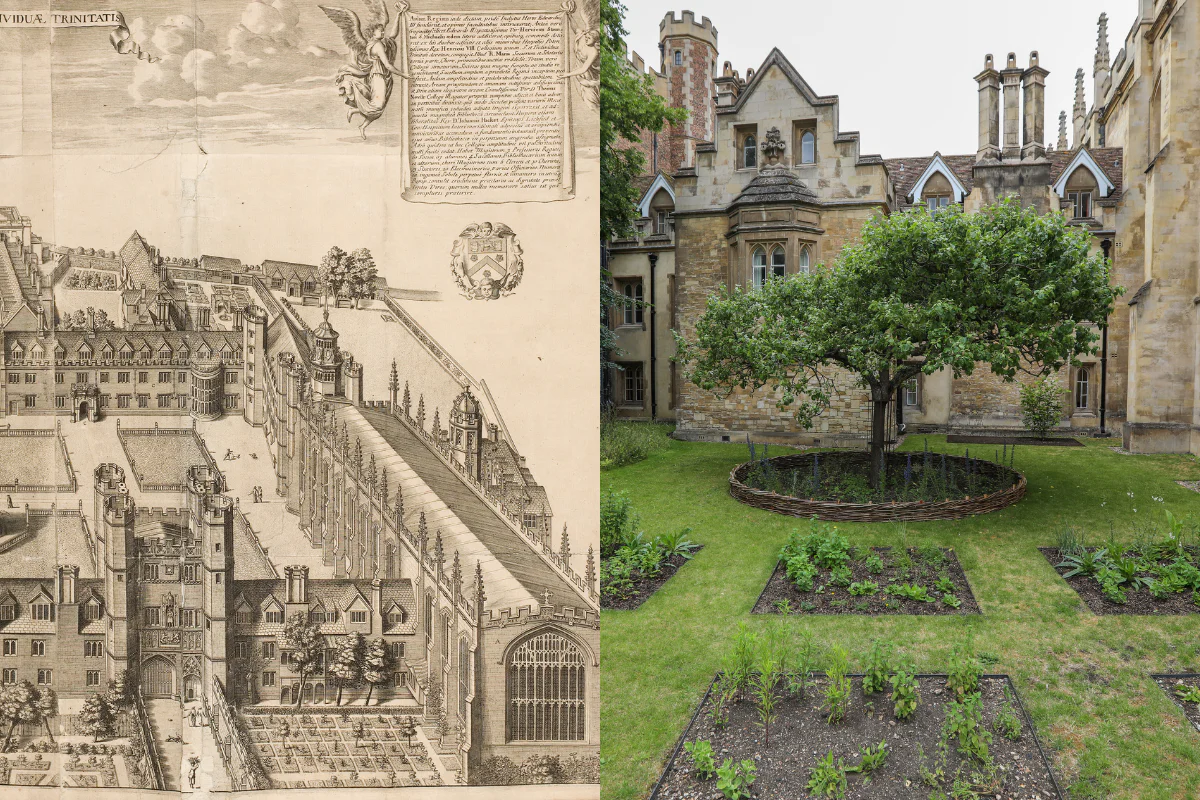
Trinity’s gardeners have reimagined the College garden created by alumnus and botanist John Ray (1627-1705) on what was ‘perhaps the most scientifically important piece of land in seventeenth-century England.’
Hitherto known as ‘Newton’s Lawn’ – due to the apple tree (grafted from the famous original at his Lincolnshire home) – Ray’s Garden has been reinvented to mark the 400th anniversary of the botanist’s birth on 29 November 2027.
The garden tells a story about both John Ray and Isaac Newton (1642–1727), who arrived at Trinity in 1661, a year before Ray left. In 2027, Trinity College will mark 400 years since the birth of John Ray in 1627 and 300 years since the death of Isaac Newton in 1727.

John Ray was a remarkable botanist whose legacy includes establishing species as a unit of taxonomy, classifying plants systematically and publishing more than 20 works about plants, birds, animals and theology.
As a Trinity Fellow, he taught mathematics, philosophy, literature and Greek, but his real passion was plants. He was among the first to study them not only for their agricultural, horticultural or medicinal uses, but also in their own right. He was also the first to document the flora of an English county.
He created a garden at Trinity in the mid-1650s with plants collected on his travels on foot and horseback through Cambridgeshire while taking a break ‘for the sake of both my mind and my body.’
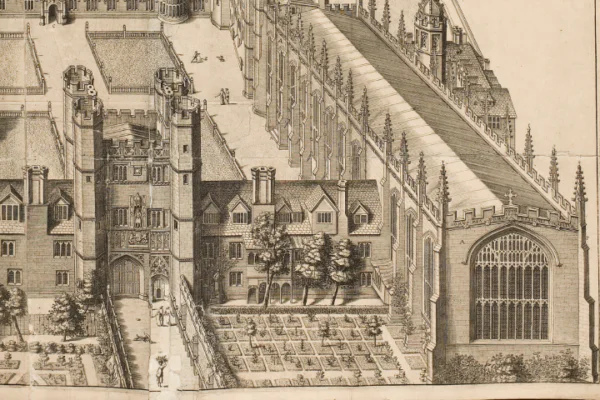
Trinity Fellow Professor Richard Serjeantson, who teaches history at the College, said the precise location of Ray’s garden was unknown but it was quite possibly on the site of the parterre-style garden facing Trinity Street shown in David Loggan’s 1690 image of the College (pictured above). He said:
In more recent times this area has become known as ‘Newton’s Lawn’ due to the fact that Newton lived in rooms overlooking Ray’s Garden where the apple tree is now planted.
Ray and Newton were both scholarship students – Ray was the son of a blacksmith – who overlapped at Trinity for a year, in 1661, when Ray was a Fellow and Newton a student.
Newton accessed the garden beside Great Gate via a staircase from his rooms above (as shown in Loggan’s engraving). Here he conducted alchemical experiments in a small laboratory, long since gone, as evidenced by metals found in the soil, including lead, iron, cobalt, copper, tin, mercury and silver.
In the reimagined garden Trinity’s gardeners have planted wildflowers, including those from Cambridgeshire, beneath Newton’s tree and woven a hazel fence around it. Trinity’s Head Gardener Karen Wells said Ray’s correspondence and publications had proved invaluable in reinventing his garden for the twenty-first century.
We selected some of the plants Ray documented planting in his garden at Trinity. We also planted other varieties found in Ray’s time in Cambridgeshire that are suitable for the location in terms of light, pollinating insects and the drier and warmer conditions we experience today.
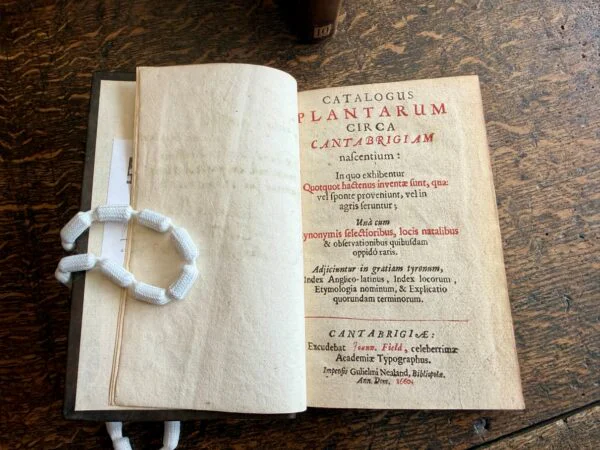
In the preface to A Catalogue of plants growing around Cambridge (1660) Ray wrote:
I had been rather unwell, and for the sake of both my mind and my body I had to take a break from more demanding studies by either riding or walking.
It was almost inevitable, especially in my more idle moments, that I should sometimes contemplate in passing the beauty and variety of the plants – nature’s intricate handiwork – that I could see all about me, and which I so often trod underfoot. And once I had taken a closer look at them I had to get my feet wet, so to speak; I couldn’t regard them as negligible any more.
What first drew me in was the splendid display of meadows in spring. Then I became delighted by the extraordinary shapes and colours of individual plants, and by their entire outward appearance: so wonderfully elegant and graceful! And as I often feasted my eyes upon them, and gladdened my mind with them, gradually an interest in botany took hold of me, and I conceived a great desire, a passion, to know more about it.
Ray certainly went on to do just that – laying the foundations for the systematic classification of plants that would later be developed by Carl Linnaeus. With Francis Willughby, another former member of Trinity, he travelled through Britain and Europe studying animals and plants. An early journey took him to Puffin Island in North Wales; a later one to the Netherlands, France, and Italy.

Professor Serjeantson said the garden was a fitting tribute to both scientists in preparation for their anniversary year.
Ray was an early fellow of the Royal Society, which Newton would later serve as President. Between them they exemplify the wide range of scientific studies already being pursued at Trinity across the later seventeenth century: botany, natural history, chemistry, physics and mathematics.
I am delighted that this garden – perhaps the most scientifically important piece of land in seventeenth-century England – has been reimagined in recognition of the achievements of both scientists.
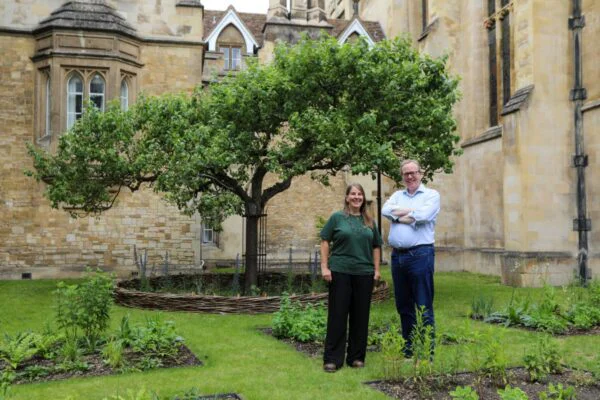
How Ray’s Garden was created
Karen Wells and the gardens team planned the garden by looking at the Loggan engraving of Trinity and reading John Ray’s Cambridge Catalogue (1660), translated and edited by PH Oswald and CD Preston, as well as the botanist’s later History of Plants.
They also considered the correspondence of another Trinity alumnus, Samuel Corbyn, who listed wild and cultivated plants in two letters sent in 1656 and 1657.
To prepare the ground at Newton’s Lawn, the gardeners relocated the crocuses. They wove a hazel fence around the apple tree to create an understorey of wildflowers. Behind the apple tree is a bed planted with a hazel tree, which will be used to repair the woven fence if and when needed.
The flowerbeds echoing Ray’s original design were framed in metal for longevity and filled with the gardeners’ homemade compost and sand, as well as the original soil.
The flowerbeds have various orientations and have been planted accordingly.
Ms Wells said: ‘I chose plants suitable for the light levels or aspect of the bed, and for sandy soils or loam, plus plants that are drought tolerant. The vast majority of the plants attract pollinators, which we will record over time. At the moment there are 28 species of plants, more will be added.’
The list of plants in Ray’s reimagined garden
Below are the plants in the garden listed by botanical and common names, followed by Ray’s comments. These plants were documented by Ray himself or by Corbyn in his letters.
Agrimonia eupatoria – Hemp Agrimony
Ajuga reptans – Bugle
Armoracia rusticana – Horseradish: ‘It was found at Magdalen College close, but since has been mostly dug up and carried away.’
Briza media – Common Quaking Grass / Cow Quake / Didder: ‘In meadows and pastures.’
Campanula glomerata – Clustered bellflower: ‘On Gogmagog hills, Newmarket Heath, Little Shelford churchyard and elsewhere many other places.’
Chenopodium bonus-henricus – Good King Henry: ‘The younger shoots of this plant out into boiling water and cooked for a quarter of an hour, then eaten with butter and salt, make a pleasant and health giving dish not unlike ordinary asparagus.’
Clinopodium vulgare – Wild Basil: ‘In hedgerows in various localities.’
Corylus avellana – Hazel
Dryopteris filix-mas – Male Fern: ‘In Shropshire it is often used when dried instead of hops in the brewing of beer.’
Erysimum cheiri – Common Wallflower: ‘Everywhere on walls.’
Eupatorium cannabinum – Hemp Agrimony
Helianthemum nummularium – Common Rockrose: ‘All over Gogmagog hills and Newmarket Heath.’
Hylotelephium telephium – Orpine: ‘In a lane at Shelford.’
Inula helenium – Elecampane: ‘In fields about Madingley in great plenty and at Barton and many other places.’
Origanum vulgare – Wild Oregano
Silybum marianum – Milk Thistle ‘Milk thistle or Ladies Thistle’ (‘self-seeded.)
Allium x proliferum – Tree Onion
Astrantia major – Masterwort
Betonica officinalis – Betony: ‘We cultivated this, obtained from London, for several years in Cambridge in our little garden.’
Cirsium tuberosum – Tuberous Thistle
Digitalis ferruginea – Rusty Foxglove
Geum x intermedium – Wood Avens: ‘This was found in the fields somewhere about the town and brought into our gardens.’
Nepeta cataria – Catmint: ‘This mint when transplanted from fields into gardens, we have seen bruised by cats, their whole bodies abandoned to rolling around.’
Pulsatilla vulgaris – Pasque Flower: ‘In our experience even in garden-grounds in quite fruitful & rich soil and in a place that is not too sunny it grows successfully.’
Saxifraga x urbium
Seseli libanotis – Moon Carrot
Solidago virgaurea – Goldenrod
Verbascum blattaria f. Albiflorum – white-flowered moth mullein: ‘It grows from its fallen seed, as we have experienced sometimes in our little garden in Cambridge.’
Sources:
John Ray’s Cambridge Catalogue, 1660, (2012) translated and edited by PH Oswald and CD Preston.
Historia Plantarum (1686, 1688, 1704), J Ray.
‘Wild and cultivated plants in Cambridge, 1656–1657: a re-examination of Samuel Corbyn’s lists’, CD Preston, in HUNTIA 16(2) 2018.
Ray’s Flora of Cambridgeshire (1975) translated and edited by AH Ewen and CT Prime.
Photos: Images of the engraving and oil painting, courtesy of the Wren Library, Trinity College Cambridge; other photos by Elly White, Trinity College Cambridge.