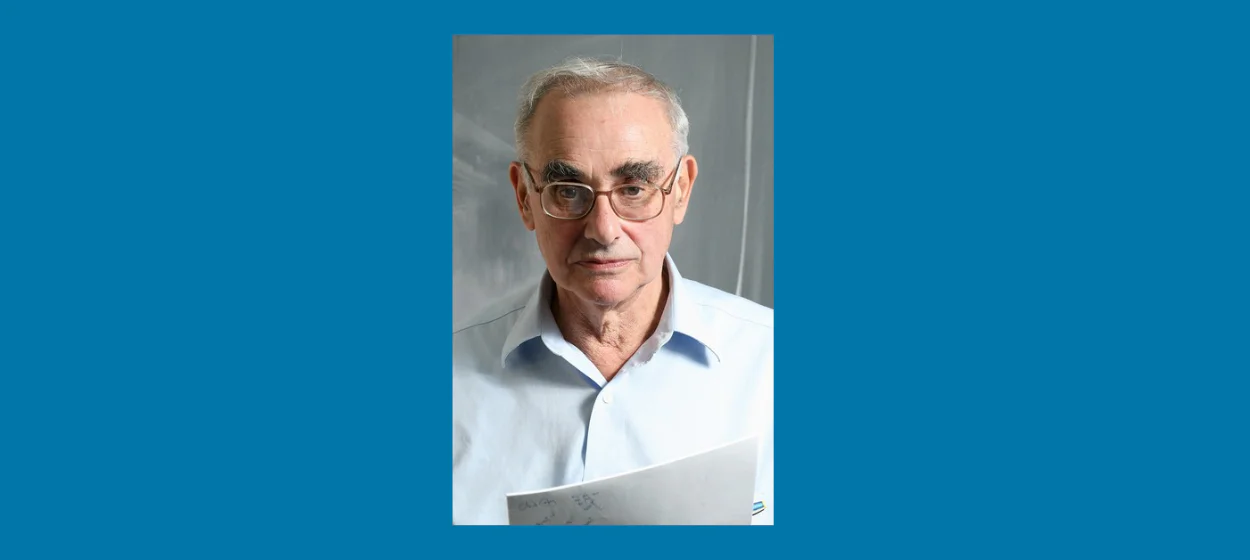
A pioneer in quantum field theory, string theory and quantum computing, Jeffrey Goldstone (1933-2026), Honorary Fellow of Trinity and Emeritus Professor at MIT, died on 12 October 2026.
Jeffrey Goldstone was born in Manchester and attended Manchester Grammar School. He arrived at Trinity for his undergraduate degree in 1951, having achieved the highest mark ever in the College entrance exam, which prospective students of the time had to sit.
He went on to a PhD and became a Title A Fellow 1956-1960, conducting postdoctoral work at Harvard, CERN, and Copenhagen. During this time his research focus shifted from nuclear matter to particle physics. Jeffrey Goldstone was elected to a Teaching Fellowship and was a Director of Studies in Mathematics at Trinity until 1976.
Although he wrote very few papers in his early career, all of them were insightful and important, said Professor Hugh Osborn, Trinity Fellow in Mathematics.
In 1959 he showed how what were called spontaneously broken symmetries led to the appearance of massless particles. It was soon realised that these ideas were directly relevant to the real world of particle physics and they are now called Goldstone bosons and play a crucial role in our understanding of this area of physics.
The former Master of St John’s College and Trinity alumnus Professor Peter Goddard, now Emeritus Professor at the Institute of Advanced Study, said:
Jeffrey Goldstone’s research profoundly influenced the development of quantum field theory, string theory, and quantum information theory. In the 1960s, he was already renown for the extraordinary depth of his understanding of quantum physics and internationally leading physicists beat a path to his door. His desk was layered with pages of insights, judged insufficiently complete to meet his own formidable standards, and periodically swept into the wastepaper basket at the end of the table.
Trinity Fellow, Professor of Theoretical Physics at Cambridge, David Tong said Professor Goldstone was ‘truly one of the giants of twentieth-century physics.’
Goldstone bosons are one of the great unifying ideas of twentieth-century physics, in which understanding symmetries of a physical system tells you about the collective motion of its constituents. Sound waves in solids, movement of spins in magnets, elementary particles called pions, superfluids and superconductors, even the way flocks of birds or schools of fish rotate – all of them can be understood in the language of Goldstone bosons that Jeffrey introduced.
Professor Goldstone moved to MIT in 1977. From 1983 he was the Cecil and Ida Green Professor of Physics, and Director of the MIT Center for Theoretical Physics 1983-1989. After retiring from MIT in 2004, Professor Goldstone continued research for the next two decades, working in quantum computing where he developed new algorithms.
Those who knew Professor Goldstone during his time in Cambridge remarked on his intellectual abilities and his humanity. Professor Goddard said:
I was greatly privileged to know Jeffrey when I was a student and then later as a collaborator. Responding to a letter, he wrote, in typical fashion, “in reply to your questions, I have no answers, only further questions”, before comprehensively answering all the questions and driving the discussion far deeper. He was a person of the greatest intellectual integrity and commitment.
Professor Osborn said: ‘We had many discussions on physics. Whenever he sought help on some problem, he inevitably could solve it in the course of explaining it.’
Dr Anil Seal, Trinity Fellow in History, said:
Jeffrey was very much a Mancunian (half a century in the States did nothing to change not even one tone in his accent).
In his politics (about which he was quietly committed, ‘old Labour ‘of the Attlee – Bevan variety) and in his views on all matters, he was in the best sense of the word a true liberal and a man of the very greatest intelligence but engaging humanity.
Professor Goldstone was elected a Fellow of the Royal Society and the American Academy of Arts and Sciences in 1977 and became a Fellow of the American Physical Society (APS) in 1987.
His honours included the Guthrie Medal of the Institute of Physics, the Dannie Heineman Prize for Mathematical Physics of the APS, and the Dirac Medal of the Abdus Salam International Centre for Theoretical Physics (ICTP), which was awarded for ‘his fundamental clarification of the phenomenon of spontaneous symmetry violation in relativistic field theory.’
Professor Goldstone was elected an Honorary Fellow of Trinity in 2000.
Photo above: Courtesy of MIT Department of Physics.