
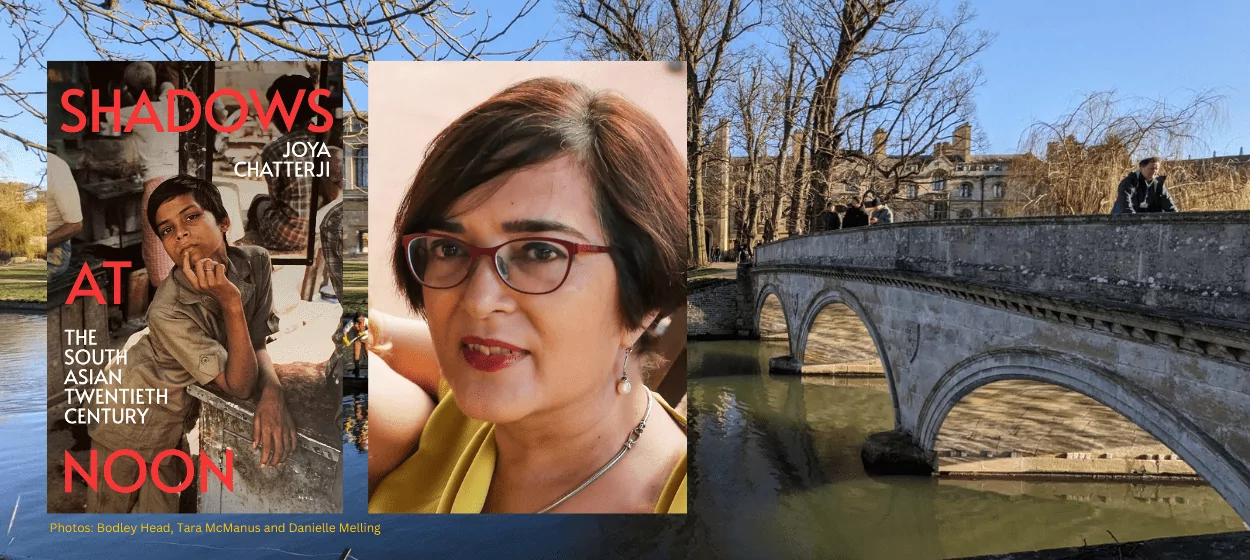
Joya Chatterji, Emeritus Professor of South Asian History at Cambridge, has won the Wolfson History Prize 2024 for Shadows at Noon: The South Asian Twentieth Century.
Professor Sir David Cannadine, Chair of the Wolfson History Prize judges, said:
Shadows at Noon is a highly ambitious history of twentieth-century South Asia that defies easy categorisation, combining rigorous historical research with personal reminiscence and family anecdotes.
Chatterji writes with wit and perception, shining a light on themes that have shaped the subcontinent during this period. We extend our warmest congratulations to Joya Chatterji on her Wolfson History Prize win.
Professor Chatterji was one of six shortlisted authors for the prestigious Wolfson History Prize, now its 52nd year, which recognizes history writing that combines excellence in research with readability for a general audience.
Shadows at Noon (Bodley Head) pushes back against standard narratives of the subcontinent that emphasise the differences between India, Pakistan, and Bangladesh, and instead seeks to highlight what unites these three nations and their peoples.
Interwoven with her reflections on growing up in India, Professor Chatterji adopts a conversational writing style and takes a thematic rather than chronological approach. Everyday experiences of food, cinema and the household are given an equal footing to discussions about politics and nationhood.
The Wolfson History Prize judges described the Shadows at Noon as ‘a captivating history of modern South Asia, full of fascinating insights into its peoples.’
Professor Chatterji agreed with the characterisation of the book the ‘genre-defying.’
Shadows at Noon is genre-defying in two senses (at least). It draws not only on history but on a host of subjects including earthquake studies and Islamic banking, microcredit and artisanship, museum studies and Bollywood, and brings them together in ways never done before.
It is also genre-defying in the manner of telling. I reject the omniscient author tone for one of a fellow questioner, no less confused as a child as to what was what and why it was so. The memoir element in the book provides the reader with a sense of intimacy to themes they might otherwise find it hard to digest,’ she said.
The large theme is perhaps the most radical and novel. The book shows how similar India Pakistan and Bangladesh have been as nations despite the hysterical narratives of undying enmity.
Shadows at Noon has received the Prize for the Book of the Year by Eastern Eye and Amrita Bazaar Patrika Group of newspapers and magazines, as well as the Los Angeles Times Book Prize for History. It was also longlisted for the Women’s Prize for Non-Fiction 2024 and shortlisted for the Cundhill History Prize.
The Wolfson History Prize is the most valuable history writing prize in the UK, with £50,000 awarded to the winner and £5,000 each to the other shortlisted authors, who include Trinity alumna Professor Nandini Das for Courting India: England, Mughal India and the Origins of Empire (Bloomsbury Publishing).