
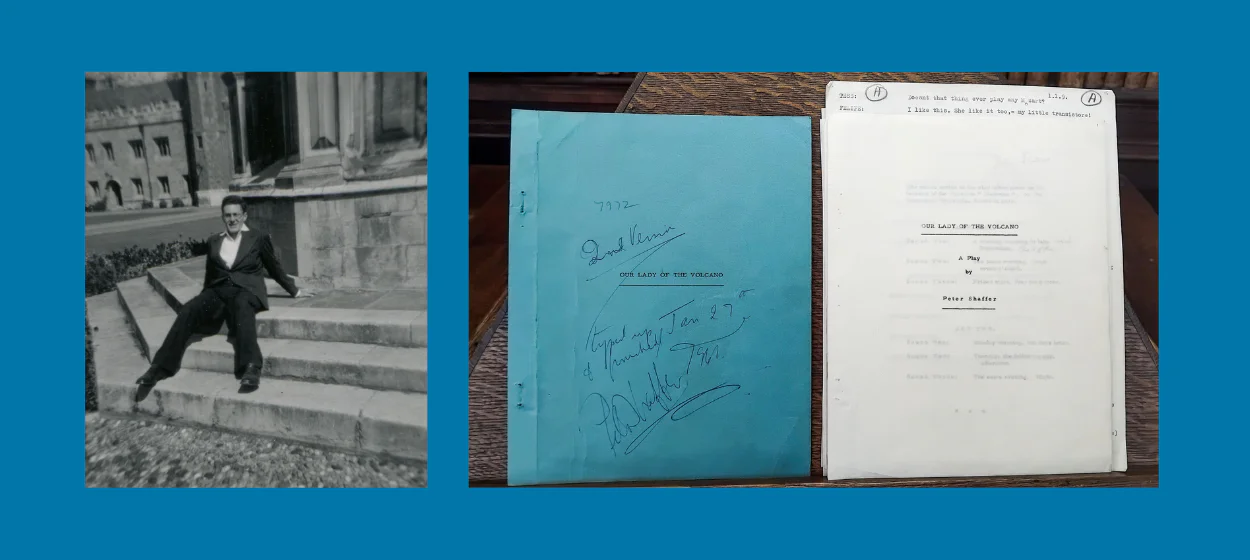
Trinity PhD student James Critchley has unearthed a complete, unpublished play 65 years after Sir Peter Shaffer wrote it – and before he reignited the world of theatre with the acclaimed plays The Royal Hunt of the Sun, Equus, and Amadeus.
Trinity College is celebrating the centenary of the birth of twin brothers Peter Shaffer (1926-2016) and Anthony Shaffer (1926-2001) who both studied at Trinity and went on to become award-winning playwrights. Peter Shaffer bequeathed his substantial archive of playscripts, correspondence and photographs to Trinity College.
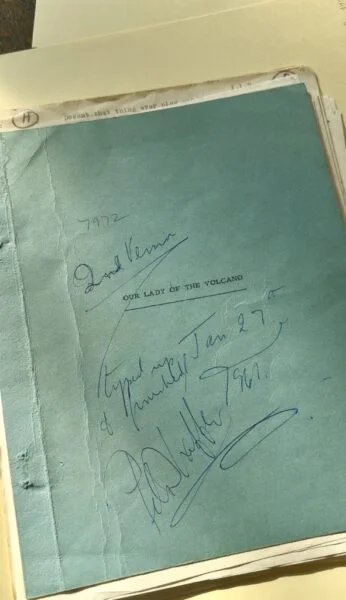
James Critchley came across the unstaged play Our Lady of the Volcano while working on Shaffer’s first play, Five Finger Exercise. The play had been catalogued by archivists, but has remained largely unknown. Our Lady of the Volcano reflects the importance of Italy in Shaffer’s creative life.
Set on the sultry Amalfi Coast, the plot swirls around two British travellers staying in a villa and their interactions – for better or worse – with other residents.
It’s about competing kinds of romance narratives, primarily relating to the Brando-esque Jim Suckling, and his various encounters in relation to a religious festival near Sorrento.
And in this kind of steamy, tempestuous sensuality, you can see the growing influence of writers such as Tennessee Williams, who Shaffer admired.
James said the play was intriguing for its cinematic influences, at a time when Hollywood films set in Italy – among them Roman Holiday, Three Coins in the Fountain, Boy on a Dolphin – proved highly popular.
It emerges from a real immersion in the cinematic world of the early 1960s – these films made in Italian studios fed into Shaffer’s thinking. It was quite unusual at the time to see a play set outdoors, in an Italian villa, so the play is an example of him thinking across different media.
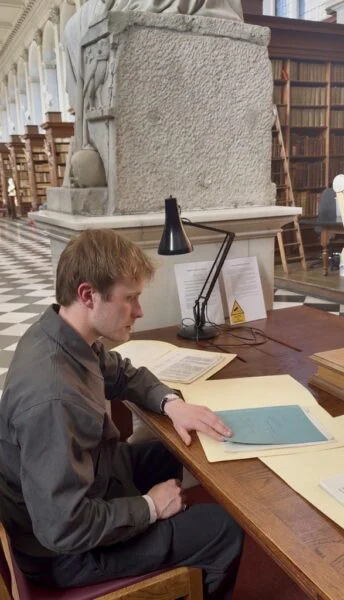
Our Lady of the Volcano marks a transition in the playwright’s early work, said James.
Shaffer longed to leave behind the world of slammed doors and actual breakfasts being consumed in an atmosphere of domestic tension. He wanted to reinvent theatre.
Of course, in later plays like Royal Hunt or Amadeus, he can be seen confidently working towards what he called ‘Total Theatre’: a mode of performance in which music, mime, movement might all play a role as important as scripted text.
Even though the play never made it to stage, it is fascinating to see a writer developing his craft: to peek, as it were, behind the curtain. We can see in Our Lady ideas and scenarios that he would go on to flesh out more fully in the mature works of his later career.
James, who began exploring the Shaffer Archive as an undergraduate, said his PhD offered an amazing opportunity to understand Shaffer’s evolution, as well as the ups and downs charted in his correspondence. ‘It’s really exciting to be up close and personal so to speak with the projects that didn’t necessarily make it to publication, but which still have all of the kind of thrilling imprints of a writer whose legacy continues to flourish today.’
The Shaffer Archive is a unique part of British theatrical history. Researchers are welcome to book an appointment to view it (please see below.)
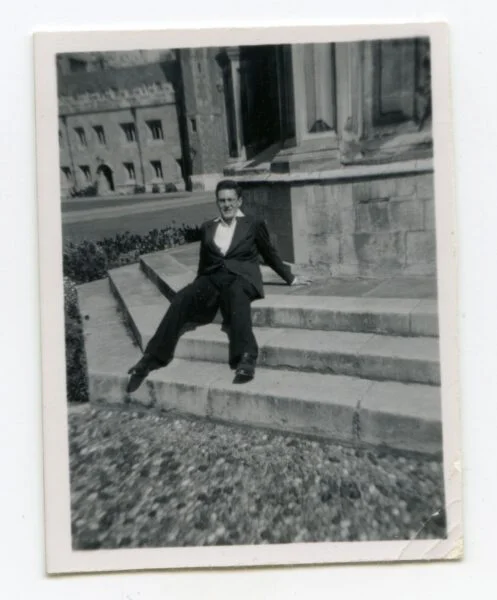
Shaffer at Cambridge
Peter and Anthony Shaffer were conscripted to the coal mines in Kent as ‘Bevin Boys’ during the Second World War. After that, in 1947, aged 21, they arrived at Trinity, Anthony to study Law and Peter, history.
Peter Shaffer described student life as ‘heaven’ and Cambridge ‘an astonishing place for many reasons.’ He attended lectures of all kinds, including by the philosopher Bertrand Russell, and he met EM Forster at King’s College, where the novelist was an Honorary Fellow.
Peter entered a short story competition set by Forster and although he did not win, he did receive an invitation to tea. He recalled:
I said I would love to have tea with him and I went round in some awe of the great man. And he served me tea and he was very shy. … it was tremendously encouraging … the fact that he liked the story and it had merits and he had a way of conveying its demerits … that was very, very graceful.
Enduring legacy
Peter Shaffer’s breakthrough came in 1958 with Five Finger Exercise. He would go on to write acclaimed plays that continue to be staged today: a production of Equus opens in London this month and a major new production of Amadeus has been announced for 2027 in the UK. Last December Trinity alumnus Will Sharpe directed Amadeus for television, playing the title role himself.
Anthony Shaffer trained as a barrister, but devoted his life to stage and film following the success of Sleuth in 1970. His film credits include Hitchcock’s Frenzy and the cult classic The Wicker Man.
In the centenary year, Trinity will announce the fifth Shaffer Playwright-in-Residence, a studentship established with funding from the Sir Peter Shaffer Charitable Foundation for early-career playwrights.
More information
A catalogue of the Sir Peter Shaffer Archive at Trinity College is accessible online: Papers of Sir Peter Shaffer – archives.trin.cam.ac.uk
Researchers are welcome to consult items in the archive by appointment with the Wren Library.
James Critchley has written an essay for The Times Literary Supplement: An unpublished play by Peter Shaffer
His research is funded by the Alice and James Penney Studentship in English Literature.
Banner images: courtesy of the Sir Peter Shaffer Charitable Foundation/Trinity College Cambridge.