
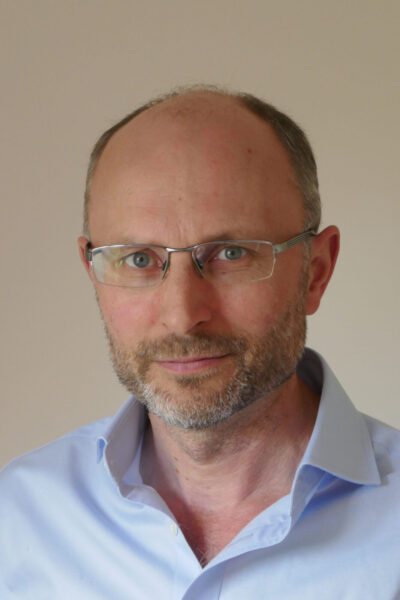

Profile
I completed my PhD in Cryogenic Combustion from Ecole Central Paris in 2001. My research focused on the stability and efficiency of rocket engines, in particular the Vulcain engine of the Ariane 5. This research showed that two seemingly-innocuous features of the fuel injectors are crucial for stability and efficiency, explaining this through experimentally-validated physics-based models.
After a year as a management consultant at McKinsey & Co., I returned to academia because I found the problems more interesting. For many years, I worked on fundamental and applied Flow Instability, in particular Combustion Instability in aircraft engines using adjoint methods. More recently, I have re-purposed adjoint methods to perform data assimilation directly into physics-based models.
I joined Trinity College in 2006, where I am Director of Studies and have been a member of the Investment Committee for several years. I have held several visiting positions, for example at Ecole Centrale Lyon, Stanford University, and IIT Madras.
In 2023/24, I served as a Commissioner for the Institute for Government’s commission on the Centre of Government (https://www.instituteforgovernment.org.uk/commission-centre-government)
Teaching
In the department, I lecture the 1st year introductory course in Fluid Mechanics and the 3rd year specialised course in Incompressible Flow.
In college, I supervise 1st year Thermodynamics.
Research
John von Neumann is quoted as saying “with four parameters I can fit an elephant and with five I can make him wiggle his trunk.” This is often (mis)-interpreted to mean that physics-based models should contain only a few parameters.
Today, however, scientists frequently use neural networks with millions of parameters containing no physics at all. What might von Neumann have said? One side argues that modelling is unnecessary because the physics is already embedded in the data. The other side argues that scientists have high quality prior knowledge such as conservation laws and values of physical quantities, so it is absurd to learn these again from data.
My research starts from this question. With adjoint-accelerated Bayesian inference, I show that we can assimilate data into physics-based models containing tens of thousands of parameters and that, by hard-wiring physics that we already know, we can extract more information about physics that we want to discover.
More details can be found on my personal website (https://mpj1001.user.srcf.net/MJ_biography.html)
Selected Publications
Bayesian inverse Navier-Stokes problems: joint flow field reconstruction and parameter learning, A. Kontogiannis, S. V. Elgersma, A. J. Sederman, M. P. Juniper, Inverse Problems 41 015008 (2025) doi:10.1088/1361-6420/ad9cb7
Optimal experiment design with adjoint-accelerated Bayesian inference, M. Yoko and M. P. Juniper, Data-Centric Engineering 5 e17 (2024) doi:10.1017/dce.2024.16
Generating a physics-based quantitatively-accurate model of an electrically-heated Rijke tube with Bayesian inference, M. P. Juniper and M. Yoko, Journal of Sound and Vibration 535 117096 (2022) doi:10.1016/j.jsv.2022.117096
Sensitivity and nonlinearity in Thermoacoustics, M. Juniper, R. I. Sujith, Annual Review of Fluid Mechanics 50 661–689 (2018) doi:10.1146/annurev-fluid-122316-045125