Profile
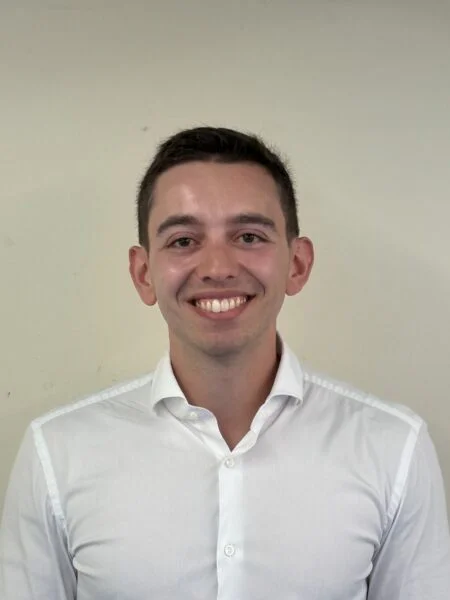
My interest in nanoscale thermodynamics started as an Engineering student at Trinity between 2014 and 2018. I then spent seven years in the United States, where I did my PhD and postdoctoral research at Stanford University, in the Department of Mechanical Engineering. I returned to Cambridge in 2025 and I am currently an Assistant Professor in Energy and a Fellow and Director of Studies at Trinity.
Teaching
I contribute to thermofluids teaching at Trinity and in the Engineering Department. I lecture part of 3A6: Heat and Mass Transfer, I help run the 3A3 Compressible Flow Lab and I supervise part IB Thermofluid Mechanics at Trinity.
Research
My research focuses on thermodynamics and energy conversion at molecular scales. One of my areas of focus is multiphase detonation, which is characterised by shock waves that are coupled with chemical reactions. Detonation-based engines can enable compact and high-efficiency propulsion and power generation. However, detonation is hard to control, because the underlying physics is not fully understood. I also study electrochemical reactions at molecular scales to help improve battery chemistry and prevent battery thermal runaway. Finally, I study the optical and electronic properties of carbon nanoparticles, which are relevant as emissions and as useful, tunable-property nanomaterials.
Selected Publications
Kateris, N., Genter, E.S., Jayaraman, A.S. and Wang, H., 2025. Theory and Canonical Experiment Development for Strong Shock-Induced Droplet Drag and Vaporization. 30th ICDERS proceedings, 115.
Wang, P.*, Kateris, N.*, Li, B., Zhang, Y., Luo, J., Wang, C., Zhang, Y., Jayaraman, A.S., Hu, X., Wang, H. and Li, W., 2023. High-performance lithium–sulfur batteries via molecular complexation. Journal of the American Chemical Society, 145(34), pp.18865-18876.
Kateris, N., Jayaraman, A.S. and Wang, H., 2023. HOMO-LUMO gaps of large polycyclic aromatic hydrocarbons and their implication on the quantum confinement behavior of flame-formed carbon nanoparticles. Proceedings of the Combustion Institute, 39(1), pp.1069-1077.
Kateris, N., Genter, E.S. and Wang, H., 2023. Shock-Initiated Fragmentation of n-Dodecane Nano-droplets: A Molecular Dynamics Study. 29th ICDERS proceedings, 268.
Kateris, N.*, Kloza, P.*, Qiao, R., Elliott, J.A. and Boies, A.M., 2020. From collisions to bundles: An adaptive coarse-grained model for the aggregation of high-aspect-ratio carbon nanotubes. The Journal of Physical Chemistry C, 124(15), pp.8359-8370.